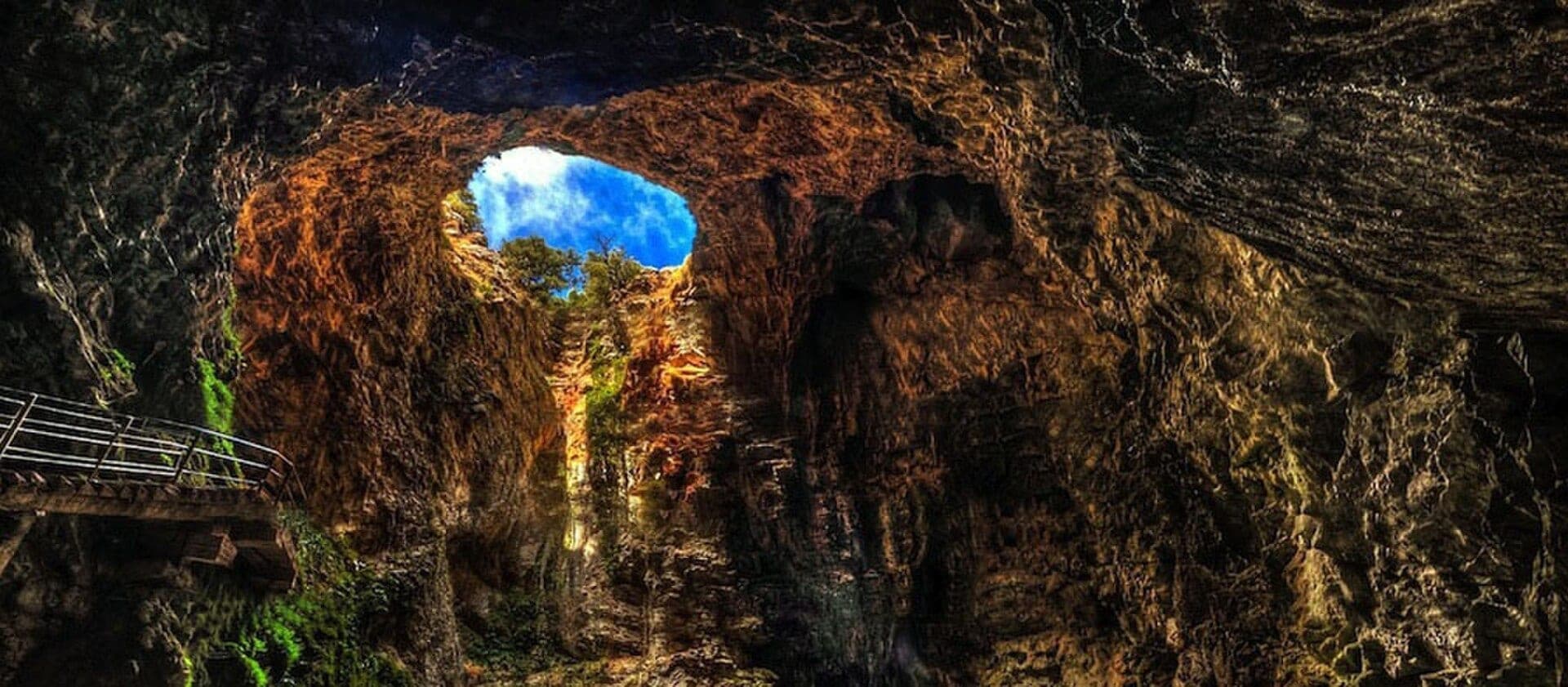
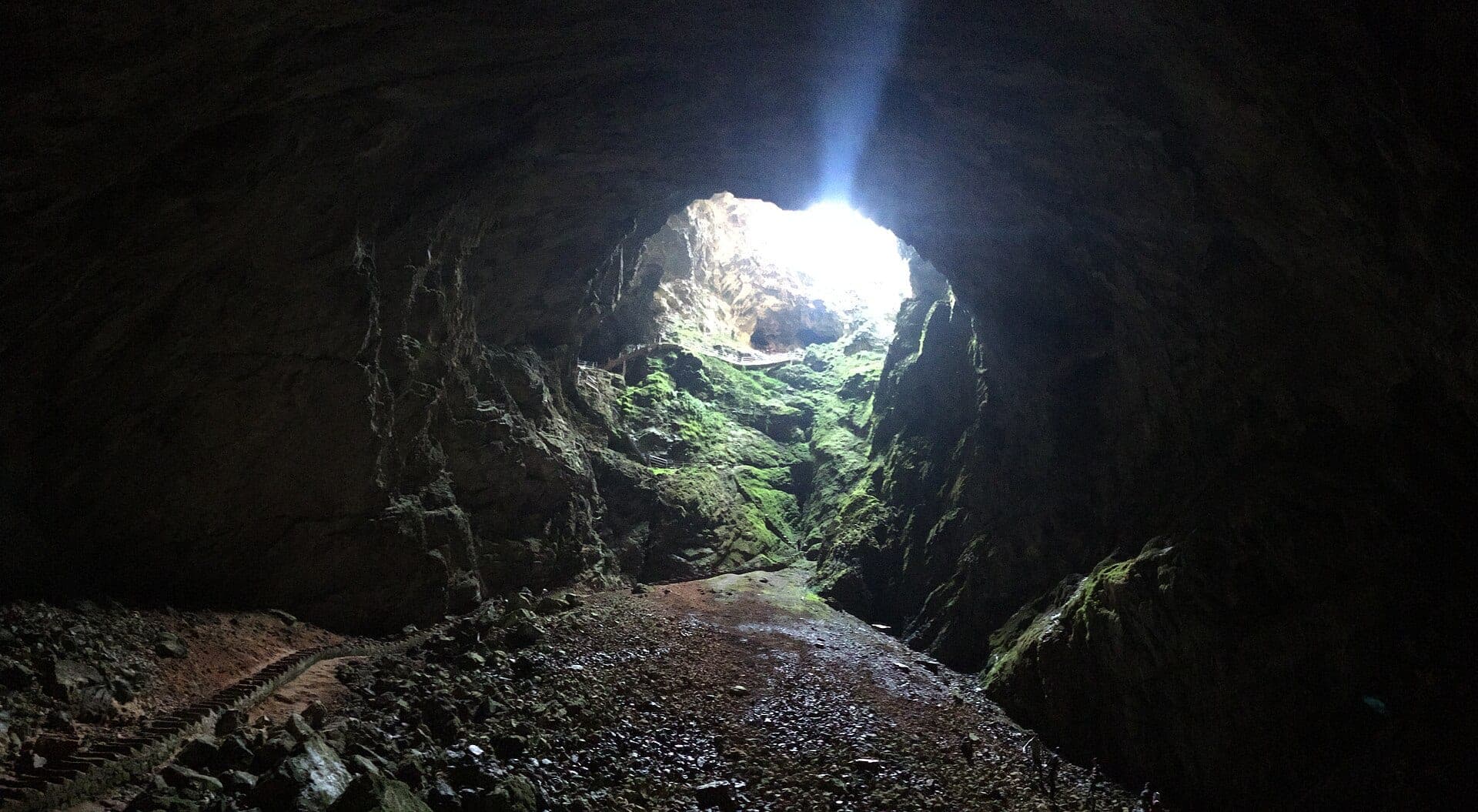
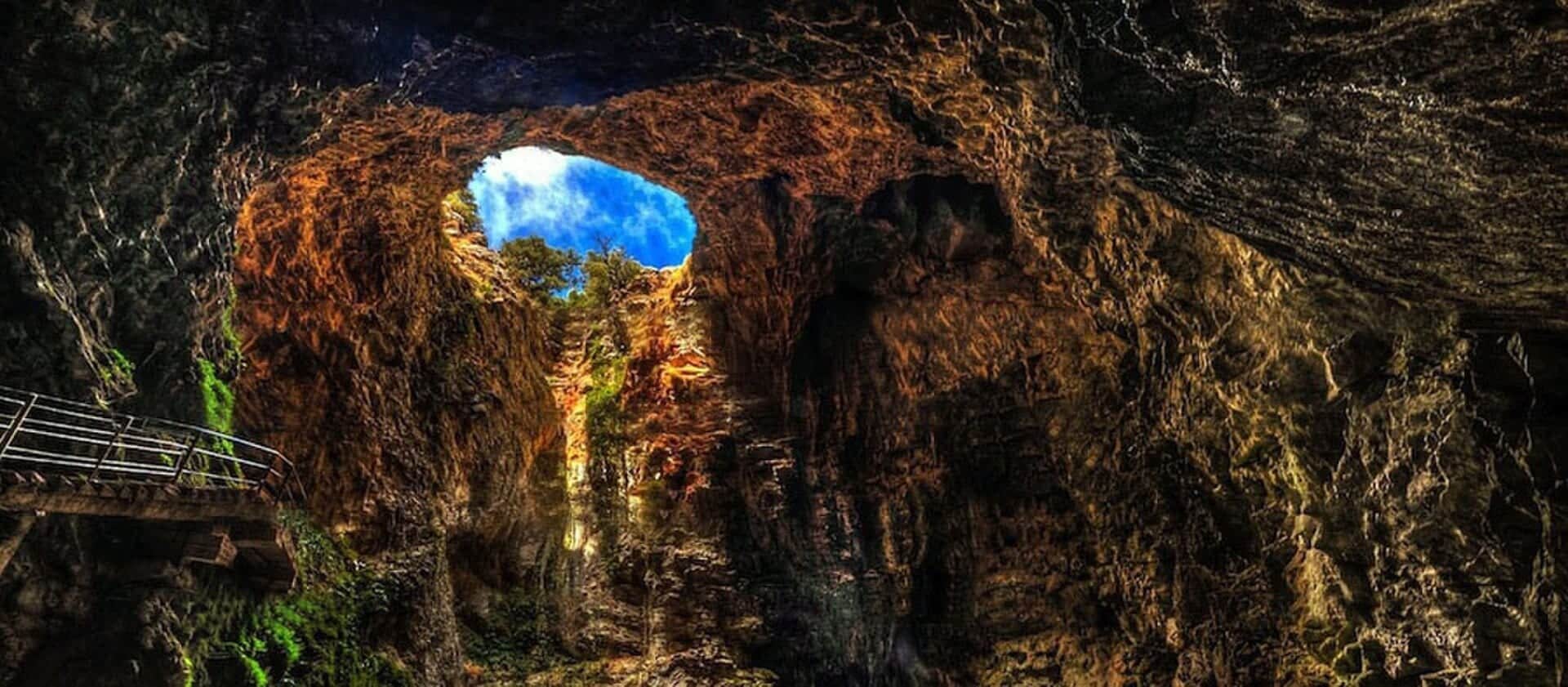
Deep Earth is a 3-day descent into one of Morocco's least-visited wonders: the Gouffre de Friouato, a colossal chasm in the hills south of Taza that is among the deepest and largest known caverns in North Africa. 'Friouato' means 'the chasm of the wind' in Tamazight, and standing at the lip of its 30-metre sinkhole, watching the staircase spiral down into the dark, you understand the name. This is the out-of-the-box line at its most literal — straight down, into the earth, somewhere the coach tours never go.
The cave is genuinely big. Its explored depth is about 271 metres and its surveyed passages run over 2,000 metres; the public route descends roughly 520 steps through the entrance shaft into the great chambers below, where stalactites and stalagmites fill rooms with names like the Salle de Lixus and the Salle des Draperies. The lower cave holds a constant 12–14°C year-round. It was first properly explored by the French speleologist Norbert Casteret in 1930, who reached 146 metres and found the underground river; later expeditions pushed further. A full visit is at least three hours, and the climb back up the 520 steps is the price of admission — this is an active descent, not a stroll.
Above ground, the cave sits inside Tazekka National Park: 12,000 hectares of Atlas cedar forest around Jbel Tazekka (1,980 m), a BirdLife Important Bird Area, and home to the reintroduced Barbary stag — the Atlas deer, brought back to Morocco in 1994 from Tunisian stock after it went locally extinct. We weave the park's forest and its conservation story into the trip, and spend time in Taza, a walled hill town with a long history and almost no tourists.
An honest, important note. The Friouato cave was closed to visitors in 2016 after a fatal accident, and has since been undergoing a major safety renovation (rockfall stabilisation, a rebuilt staircase, stainless walkways and new lighting), which was reported around 90% complete in 2025 with reopening expected. Because a reopening date is exactly the kind of thing operators get wrong, we confirm the cave's status before every departure. If it is not yet open when you travel, we run the tour to the nearby Chiker grottoes and the Tazekka cedar forest instead, and tell you honestly in advance. We would rather move the plan than sell you a closed cave.
- The Gouffre de Friouato — 271 m of explored depth and over 2,000 m of passages, among the deepest and largest known caverns in North Africa
- The descent: a ~30-metre-wide sinkhole and roughly 520 steps down into the great chambers (the Salle de Lixus, the Salle des Draperies) of stalactites and stalagmites
- A constant 12–14°C in the lower cave — another world beneath the Middle Atlas, first properly explored by Norbert Casteret in 1930
- Tazekka National Park — a 12,000-hectare reserve of Atlas cedar, with the reintroduced Barbary stag (Atlas deer) and a BirdLife-designated Important Bird Area
- A certified caving guide, helmet, headlamp and safety gear — a real descent, done properly, in a place with almost no organised-tour supply
- Taza itself — a walled hill town the tour circuit forgets, and the quiet Middle Atlas around Jbel Tazekka (1,980 m)
Dia a dia
- Dia 1
Fes → Taza
Morning pickup in Fes and the drive east to Taza, about 2.5 hours — a walled town on the historic corridor between the Rif and the Middle Atlas, almost entirely off the tourist circuit. Afternoon to settle in and explore the old medina and its ramparts. Evening briefing on the cave descent: what to expect, the safety protocol, and the fitness it asks for. Overnight in Taza.
Estrada · 3h
- Dia 2
The Friouato descent + Tazekka cedar forest
The main event. Drive ~26 km up to the Gouffre de Friouato in Tazekka National Park. With helmet, headlamp and a certified guide, descend the ~520 steps through the sinkhole into the great chambers — stalactites, draperies, the constant cool, the dark. Allow at least three hours underground, including the climb back out (this is the demanding part — moderate fitness required). Afternoon in the Tazekka cedar forest above, with the park's ecology and the Barbary stag story. Second night in Taza. (If the cave is closed for renovation, we substitute the Chiker grottoes + an extended Tazekka forest day, confirmed in advance.)
Noite no destino
- Dia 3
Taza → Fes
A slower morning — the Tazekka viewpoints, or the Friouato rim again in daylight if you'd like a second look without the full descent — then the drive back to Fes by early afternoon, dropped at your riad or onward connection.
Fim da viagem
O que está incluído
- Private vehicle + driver for all 3 days (Fes ↔ Taza, daily Taza ↔ cave transfers)
- Certified caving guide + personal safety gear (helmet, headlamp, overalls, non-slip overshoes)
- Friouato cave entry and the compulsory local underground guide (when the cave is open)
- Two nights Taza / Tazekka-area lodging
- Daily breakfast + most dinners
- Tazekka National Park access and cedar-forest visit
Não incluído
- International flights to/from Morocco (and Fes transfers from elsewhere)
- Lunches (kept flexible)
- Travel insurance (recommended — and sensible for an active caving trip)
- The descent itself for travellers who are not reasonably fit or who are strongly claustrophobic (we'll advise honestly)
- Single-room supplement
- Explored depth
- ≈271 m (the first ~100 m is the vertical entrance shaft)
- The descent
- ≈520 steps through a ~30 m sinkhole; visit ≥3 hours incl. the climb out
- First explored
- Norbert Casteret, 1930 (reached 146 m, found the underground river)
- 2026 status
- Closed 2016; safety renovation ~90% done in 2025, reopening expected — confirmed per departure
“Nobody puts Friouato on a Morocco itinerary, which is exactly why we do. You stand at a 30-metre hole in the ground in the middle of nowhere near Taza, and then you walk 520 steps down into a cathedral of stone. It's the most literal 'out of the box' tour we run. We're also straight with you about the renovation — the cave was closed for years for safety work, and we confirm it's open before every single departure rather than sell you a surprise.”
O que dizem os viajantes

Sophie & Marc
Paris, France
“The best trip of our lives. Our guide knew every village, every viewpoint, every hidden riad. Seven days in Morocco felt like a month somewhere else.”

James H.
London, UK
“Everything was seamless from landing in Fes to the Sahara camp and back to Marrakech. The night under the stars is something I'll never forget.”

Ana Rodrigues
Lisbon, Portugal
“Organized, warm, professional. They built the itinerary around what we loved and gave us complete freedom to stop anywhere along the way.”
Leia isso primeiro se ainda está pesquisando
Off-beatFriouato Cave, Morocco: North Africa's Great Chasm (2026 Guide)
The Gouffre de Friouato near Taza is one of North Africa's deepest and largest known caverns — a 30-metre sinkhole and about 520 steps down into chambers 271 metres deep. Here's how deep it really is, how hard the descent is, what lives in Tazekka National Park above it, and the honest answer on whether it's open in 2026.
Off-beatVale a Pena Visitar Ifrane? A Resposta Honesta de um Local para 2026
Ifrane é a cidade alpina de Marrocos — florestas de cedro, macacos selvagens, neve no inverno e uma das cidades mais limpas do país. A resposta honesta de um local para 2026 sobre se vale a pena visitar, quantos dias são necessários e como planejar a viagem sem desperdiçar.
Deep Earth: The Friouato Chasm - perguntado frequentemente
- How deep is the Friouato Cave?
- Its explored depth is about 271 metres, with surveyed passages running over 2,000 metres — among the deepest and largest known caverns in North Africa. The first roughly 100 metres is the vertical entrance shaft, descended via about 520 steps; the great chambers open up below that. (Note: Morocco's single deepest cave is actually Kef Toghobeit in the Rif — but Friouato is the great accessible show-cave chasm.)
- Is the Friouato Cave open to visitors in 2026?
- It's the key question, and we answer it honestly per departure. The cave was closed in 2016 after a fatal accident and has undergone a major safety renovation — rockfall stabilisation, a rebuilt staircase, new walkways and lighting — reported around 90% complete in 2025, with reopening expected. We confirm the live status before you book. If it isn't open when you travel, we run the trip to the nearby Chiker grottoes and the Tazekka cedar forest instead, and tell you in advance.
- How many steps are there in the Friouato Cave?
- About 520 steps descend through the entrance shaft to the cavern floor, with further steps below that into the deeper chambers. The renovation rebuilt the descent at a similar count. The climb back up the 520 steps is the genuinely strenuous part of the visit — budget time and energy for it.
- Is the cave suitable for people who are claustrophobic or not very fit?
- Honestly, not really. The descent and especially the climb back up ~520 steps demand moderate fitness, and while the great chambers are vast (not tight squeezes), the depth and darkness are a lot for strongly claustrophobic travellers. We'd rather advise you frankly beforehand than have you struggle — and the Tazekka forest and Taza town make a rewarding trip even without the full descent.
- How far is Friouato from Fes and Taza?
- The cave is about 26 km south of Taza, inside Tazekka National Park, and Taza is roughly 2.5 hours east of Fes by car. We base in Taza for two nights so the cave day is short and unhurried rather than a long round-trip from Fes.
- What does 'Friouato' mean?
- 'Friouato' means 'the chasm of the wind' in Tamazight (Berber) — a fitting name for a 30-metre sinkhole that breathes air between the surface and the deep cave. The name alone tells you the local relationship with the place is old.
- What wildlife is in Tazekka National Park?
- The park protects 12,000 hectares of Atlas cedar forest and is a BirdLife Important Bird Area. Its star species is the reintroduced Barbary stag (Atlas deer), brought back to Morocco in 1994 after local extinction; other mammals include wild boar, genet, otter and red fox. The Barbary macaque occurs in the wider Middle Atlas. We include the park's forest and conservation story in the trip.