Moulay Idriss Zerhoun is Morocco's holiest town, built around the tomb of Idris I. Here is how to visit it, and pair it with Volubilis and Meknes.
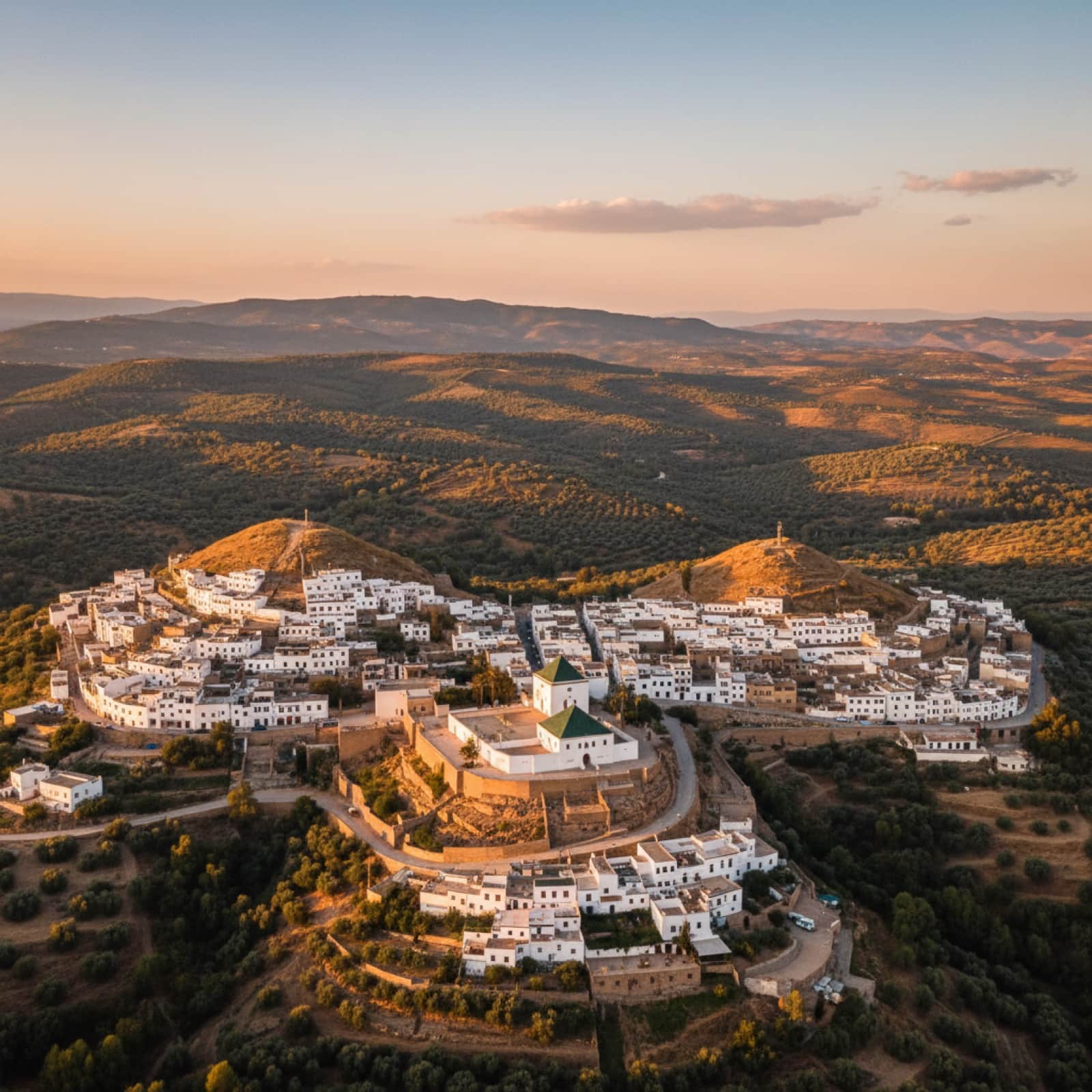
Moulay Idriss Zerhoun is widely considered Morocco's holiest town — a whitewashed maze of houses tumbling across two hills around the tomb of Idris I, who founded the country's first Muslim dynasty in 789 CE. Non-Muslims are welcome to wander its lanes but cannot enter the shrine. It sits roughly 4.5 km from Roman Volubilis and about 30 km from Meknes.
What is Moulay Idriss and why is it holy?
Moulay Idriss Zerhoun is a small hilltop town in the Fes-Meknes region, named for Idris ibn Abdallah — Moulay Idriss I — a great-grandson of the Prophet Muhammad through his grandson Hasan. He fled the Abbasid east and, in 789 CE, allied with local Amazigh (Berber) tribes to found the Idrisid dynasty, the first Moroccan Muslim state.
His tomb and zawiya (a religious complex of mausoleum, mosque and lodging) sit at the heart of the town. For Moroccans, this is the most important pilgrimage site in the country. Local tradition holds that several pilgrimages here during the annual festival carry spiritual weight of their own.
The Idrisids matter far beyond this one town. Idris I and his son, Idris II, are credited with founding Fes, which grew into Morocco's spiritual and intellectual capital. So when you stand in Moulay Idriss, you are at the cradle of more than a thousand years of Moroccan statehood and culture — the place where Islam and the Amazigh tribes of the north first fused into a single kingdom.
“I have walked clients up through these lanes a hundred times, and the moment they understand whose tomb lies under that green pyramid roof, the whole town reads differently. It stops being a pretty photo and becomes the place where Morocco's Muslim history actually begins.”
— Youssef, co-founder and lead guide, Morocco Beauty Spots
Can non-Muslims visit Moulay Idriss?
Yes. Non-Muslims are free to walk the town's streets, squares, viewpoints and shops, and most travellers spend a relaxed hour or two doing exactly that. You will be welcomed warmly, especially if you keep your shoulders and knees covered.
What you cannot do is enter the zawiya or the mausoleum itself — these remain reserved for Muslims, and a low barred gate near the main square marks the line you should not cross. Until around 2005, non-Muslims were also barred from staying overnight in the town, a custom dating to the French Protectorate of 1912 to 1956; that rule has since relaxed and guesthouses now welcome all visitors.
In practice the etiquette is simple. Walk respectfully, ask before photographing people, and do not try to peer past the gate into the sanctuary. During prayer times the main square grows quiet, which is a good moment to climb to a viewpoint instead. The town sees far fewer tourists than Fes or Marrakech, so there is almost no aggressive selling — a refreshing change for travellers who find the big medinas overwhelming.
What is there to see in the town?
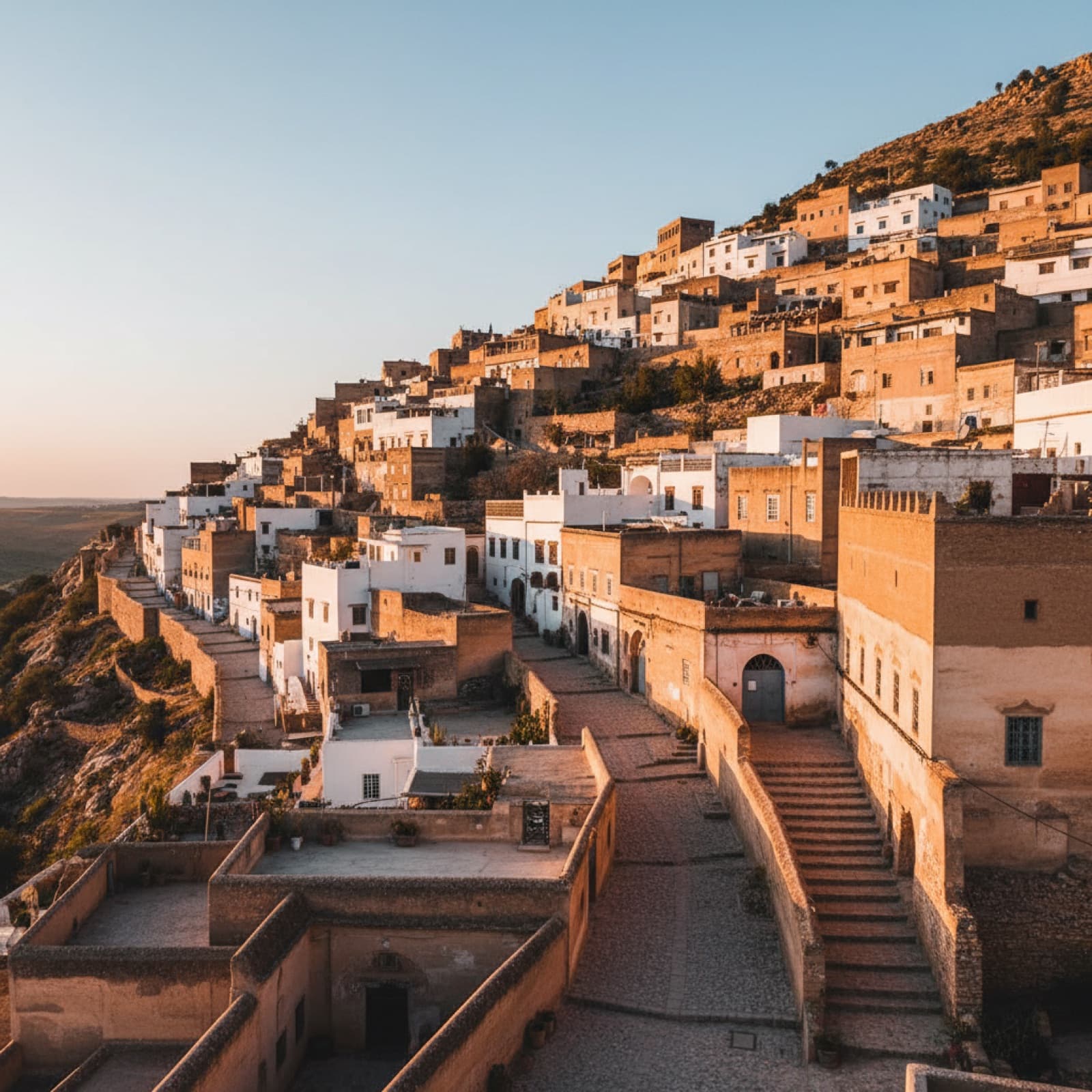
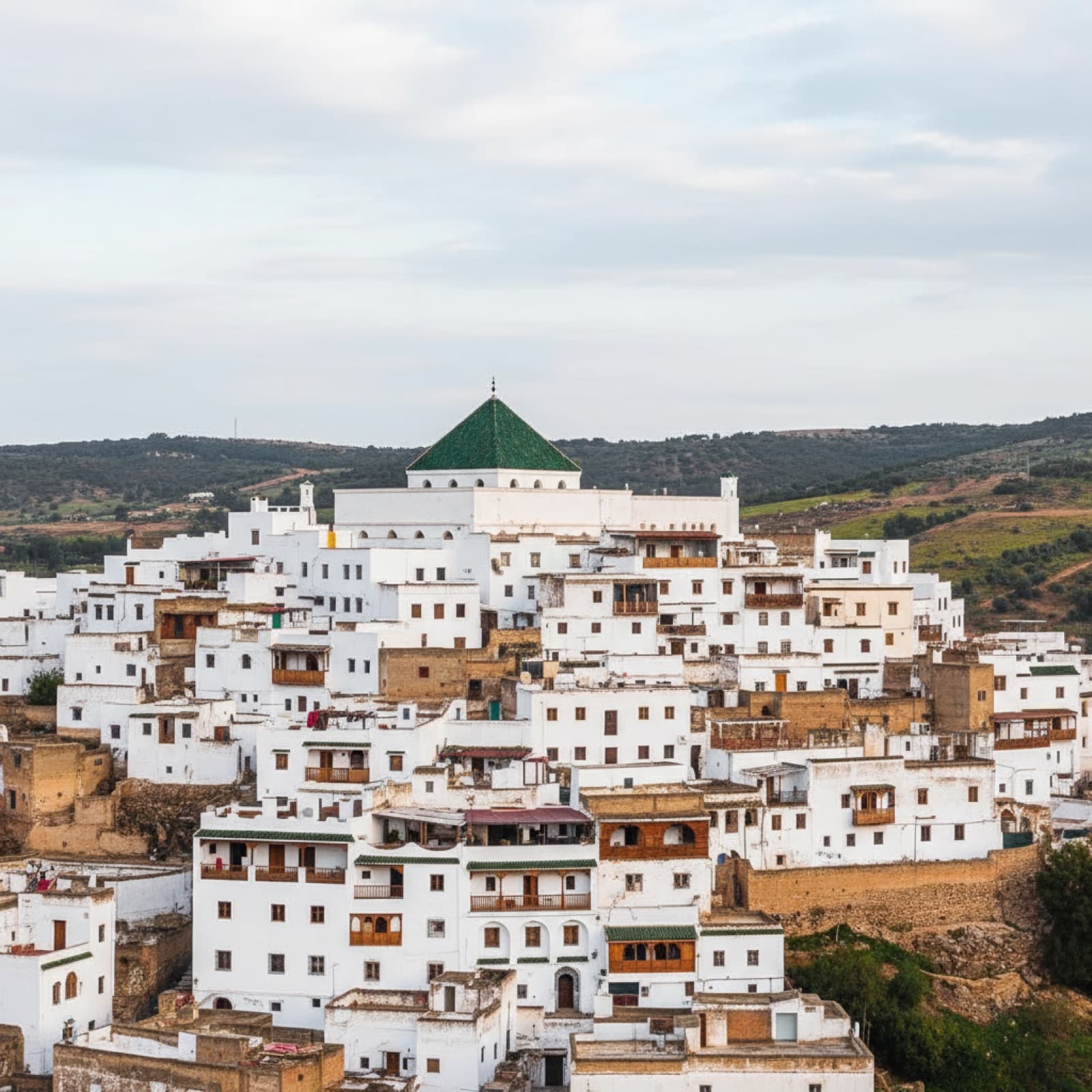
The town divides into two quarters draped over adjacent foothills of the Zerhoun mountains: Khiber and Tasga. The single most photographed landmark is the green-tiled pyramidal roof of the mausoleum, best seen from the terrace cafes that climb the hillside.
Look out for the unusual cylindrical minaret of the Sentissi mosque — said to be the only round minaret in Morocco, built in 1939 by a local man returning from the hajj. Its green tiles carry white Kufic script spelling a Quranic verse. Most minarets in Morocco are square, in the classic Almohad style, which makes this rounded tower a genuine architectural oddity worth seeking out.
A short, steep climb up the Khiber hill rewards you with two terrace viewpoints over the whole sacred bowl. The lower one frames the green pyramid roof against the houses; the upper one opens the entire valley and, on a clear day, the line of the Zerhoun mountains beyond. Bring water — the lanes are narrow, cobbled and steep, and there is no shade on the climb.
- The mausoleum's green pyramid roof, viewed from the main square or a terrace cafe
- The cylindrical Sentissi minaret, reportedly Morocco's only round one (built 1939)
- The Khiber and Tasga terrace viewpoints, a steep but short walk up
- The compact medina lanes, far quieter and less commercial than Fes or Marrakech
How does it pair with Volubilis and Meknes?
This is the smart way to visit. Moulay Idriss, Volubilis and Meknes form a natural triangle in the northern interior, and a well-paced day links all three without rushing. Volubilis — the best-preserved Roman site in Morocco and a UNESCO World Heritage Site — lies only about 4.5 km from the town, an easy short drive.
Meknes, one of Morocco's four imperial cities, sits roughly 30 km away. We usually start at Volubilis early to beat the heat, climb to Moulay Idriss for lunch and the views, then drop into Meknes for its monumental gates and granaries in the late afternoon. In Meknes the highlights are the colossal Bab Mansour gate and the vast Heri es-Souani royal granaries built under Sultan Moulay Ismail in the late 17th century.
The order matters in summer. Volubilis is an open archaeological site with no shade, so morning is far more comfortable than midday, when temperatures in this inland valley can climb above 35 degrees Celsius in July and August. Save the shaded lanes of Moulay Idriss and the covered souks of Meknes for the hotter part of the day.
| Stop | What you see | Distance / drive | Time to allow |
|---|---|---|---|
| Volubilis | Roman ruins, mosaics, basilica (UNESCO) | Start point | 1.5–2 hours |
| Moulay Idriss | Sacred town, tomb of Idris I, viewpoints | ~4.5 km / 10 min from Volubilis | 1.5–2 hours |
| Meknes | Bab Mansour gate, Heri es-Souani granaries | ~30 km / 40 min from Moulay Idriss | 2–3 hours |
How do you get to Moulay Idriss?
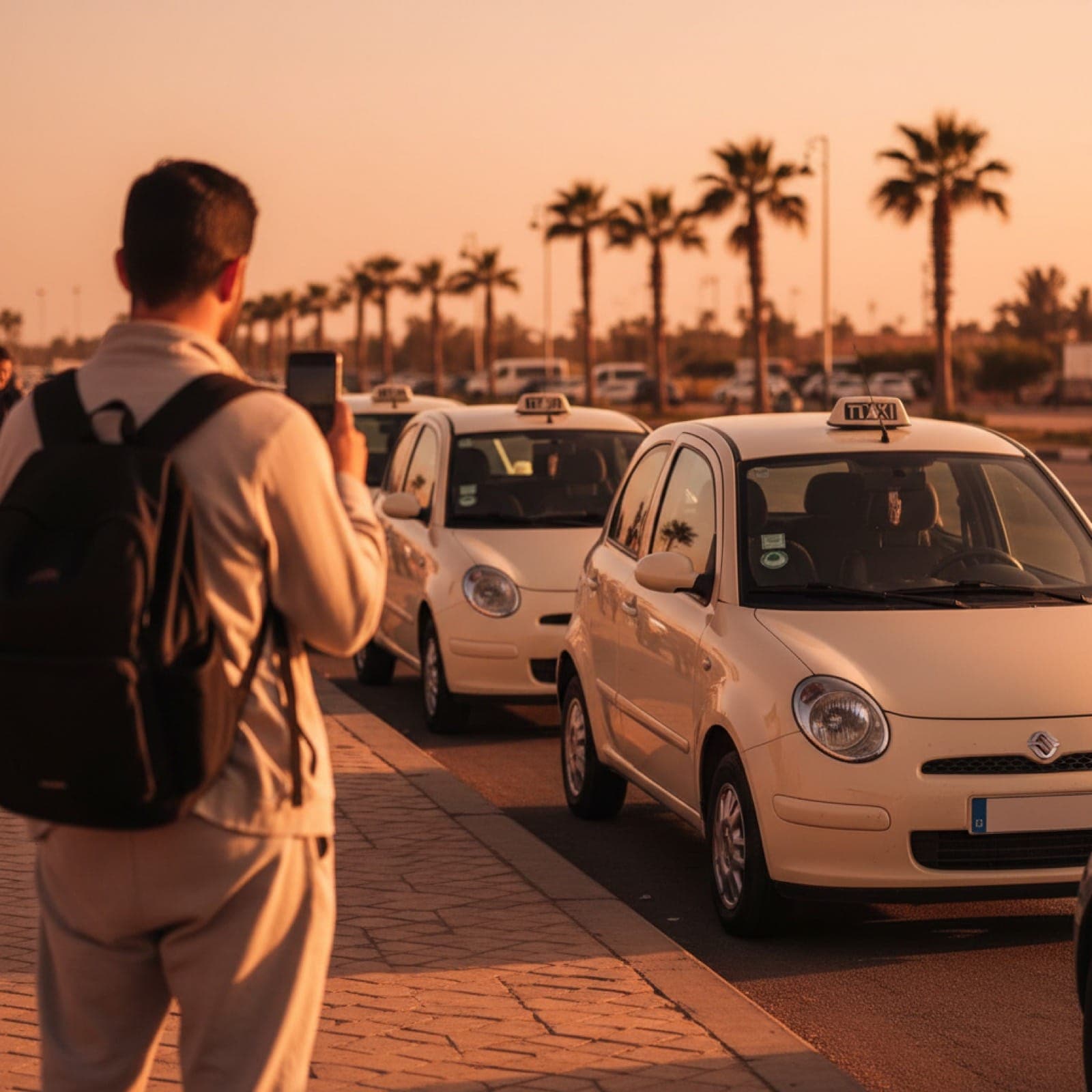
There is no train and no airport nearby, so you arrive by road. From Fes the drive is about one hour; from Meknes it is roughly 30 to 40 minutes. The town itself is closed to most vehicle traffic, so cars and buses stop at a parking area below and you walk up into the centre.
Grand taxis run from Meknes and are the cheapest option, while a private driver gives you the freedom to chain Volubilis, the town and Meknes at your own pace. Because the three sites are so close together, a private car is the option most of our travellers prefer for this particular day.
Where do you stay, and how long?
Most visitors treat Moulay Idriss as a half-day stop rather than a base, and a couple of hours is enough to walk the lanes, climb to a viewpoint and have lunch. If you want the town to yourself, though, an overnight is worth it.
A handful of small guesthouses and a few boutique riads have opened since the overnight restriction lifted around 2005. Staying over means you watch the call to prayer echo across the valley at dusk and wake before the day-trippers arrive — the town at first light is genuinely magical and almost empty.
Where you base yourself depends on your wider route. Many travellers sleep in Fes or Meknes and visit on a day trip, since both have far more hotels and restaurants. An overnight in the town itself suits photographers and slow travellers chasing the golden hour over the mausoleum roof. Either way, allow extra time: the steep, vehicle-free lanes mean every visit involves a fair bit of walking.
When does the moussem take place?
The town's biggest event is its annual moussem (religious festival), held in late summer, usually in August. It draws very large crowds of pilgrims and fills the squares with Sufi music, fantasia horseback displays and food stalls.
Non-Muslims can observe the public festivities, which are a remarkable sight, but the town is packed and accommodation is scarce during the moussem. If you prefer a calm, contemplative visit, come in spring or autumn instead — check our best time to visit Morocco guide before you fix dates.
Is Moulay Idriss worth visiting?
For travellers who want more than the standard Marrakech-and-desert circuit, yes — emphatically. It offers a window into Morocco's spiritual identity, almost no hard-sell tourism, and one of the country's most photogenic hillside panoramas, all wrapped into a single morning.
It also makes Volubilis far richer: standing among Roman mosaics with the sacred town glowing on the hill above ties two thousand years of Moroccan history into one view. If your trip already routes through Fes or Meknes, skipping it would be a missed chance.
We build this triangle into several of our northern routes — it pairs naturally with the imperial-city circuit covered in our Imperial Cities tour guide and slots neatly into a longer loop like our 7-day imperial-to-desert itinerary. For ideas on what else to fold in, see our roundup of things to do in Morocco, or browse Fes as your likely base. The most complete way to see it is our 10-Day Grand Tour of Morocco, which threads the imperial cities, this sacred town and the Sahara into one journey. When you are ready to shape your own version, tell us your dates and pace on our trip planner and we will design the day around you.
Written by
Youssef El Alaoui
Lead Morocco Specialist
Born in Fes, based in Marrakech. Designs private itineraries for Morocco Beauty Spots and still argues mint tea is best in the Atlas.