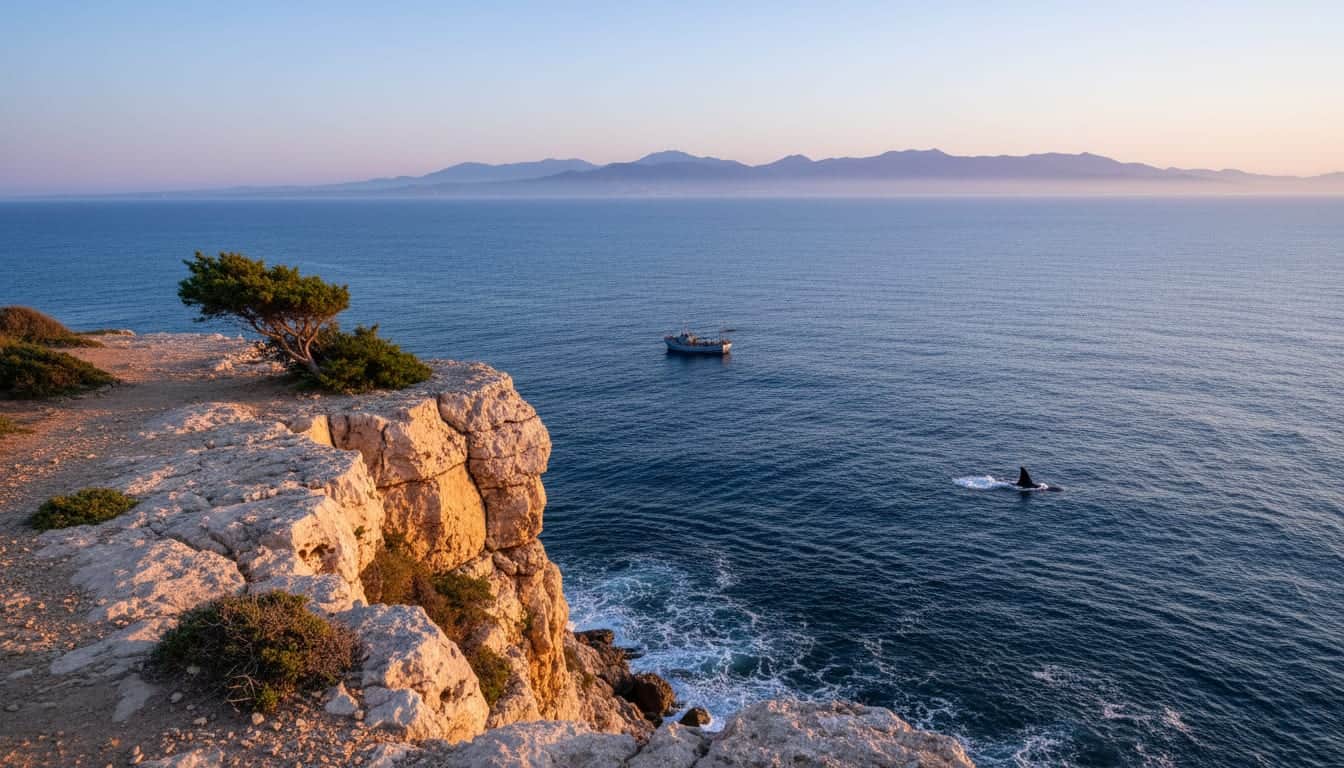
There are roughly 49 Iberian orca left, they hunt bluefin tuna in the Strait every July and August, and almost nobody runs the tour from the Moroccan side. Here's how to do it right from Tangier — when to come, what you'll see, and why the ethics matter more than the photo.
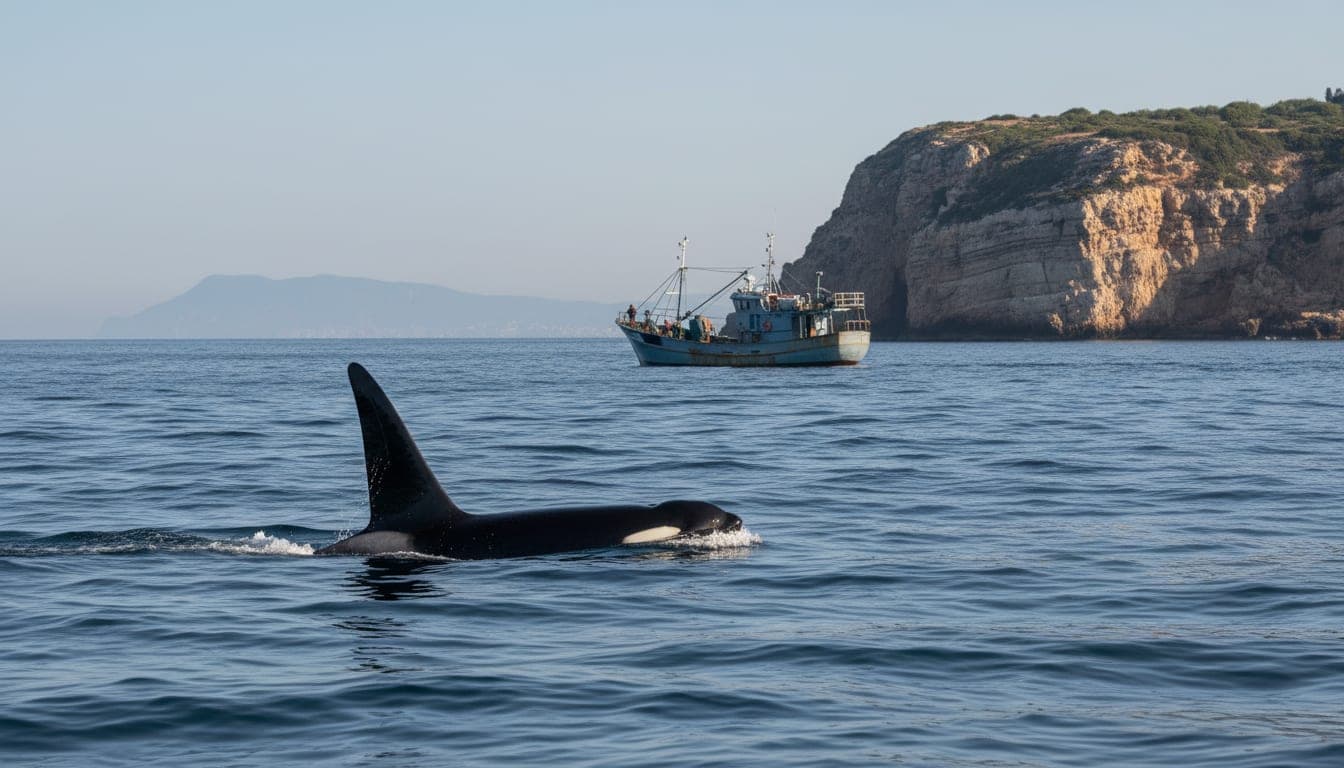
The Strait of Gibraltar has a resident population of roughly 49 Iberian orca (Critically Endangered, IUCN) that hunt bluefin tuna alongside Moroccan fishing crews every July and August. Sightings are reliable in that two-month window — roughly 70% on a single departure — and almost all the established whale-watching tours run from the Spanish side at Tarifa. From Tangier, the Moroccan flank of the Strait, the trip is shorter, less crowded, and pairs with Hercules Cave and the Roman ruins at Cotta. This guide explains exactly when to come, what you'll see, and how to book the trip without supporting the captive-cetacean industry that still operates further south on the Moroccan coast.
I've run the Tangier route for clients who'd already done the Marrakech-to-Sahara loop and wanted something nobody else was selling them. The first time I watched a Strait orca surface 80 metres off the bow, the pod was working a Moroccan fishing line — the boat I was on cut its engine, the skipper killed the conversation, and the marine biologist next to me started taking photo-ID shots for CIRCE Foundation. It was not a wildlife experience the way a safari is a wildlife experience. It was something else.
What follows is the version of the brief I send clients before they fly in. It covers the species inventory by month, the ethics protocol every reputable operator uses, the difference between the Tangier and Tarifa departures, and the small set of permits, weather windows, and pre-trip kit that actually matter.
When is the best time to see orcas in the Strait of Gibraltar?
July and August are the only realistic window for orca. The Iberian pod tracks the bluefin tuna run through the Strait during those two months, and CIRCE Foundation's 25-year monitoring dataset puts the single-departure sighting success rate around 70%. Outside Jul–Aug the orca are scattered across the Atlantic and not viable as a tour target. If orca is your specific goal, you must travel in those eight weeks — there's no shoulder season for this species.
Spring (April–June) and autumn (September–October) are excellent for the broader cetacean mix — sperm whale, pilot whale, common dolphin, striped dolphin — with near-daily sightings of at least one of those species. Winter (November–March) the cetacean activity drops sharply and no Moroccan operator runs the tour. The Strait's weather also gets rough in winter, with strong Levant winds frequently cancelling departures.
How does Tangier compare to watching from Tarifa?
Same animals, same water, different flag. Tarifa (Spain) has the mature whale-watching infrastructure: multiple licensed operators, three-hour half-day trips at €30–€50, and an established tourist circuit. Tangier (Morocco) has the same orca pod working the African flank of the Strait — sometimes literally the same animals you'd see from Tarifa, sometimes the pod splits and the African side gets the action — but almost no Moroccan-side operator currently sells the experience. The difference for you is logistical: from Tangier you can fold the cetacean day into a Moroccan itinerary (medina, kasbah, Hercules Cave, Cotta) without crossing into Spain; from Tarifa you'd need to add a ferry day each way.
There is no ethical advantage to either flag. The Iberian orca population is shared, and both Spanish and Moroccan-side operators that are doing this properly follow the same ACCOBAMS protocol. There is a difference in funding flow — a Tangier-based tour can route its conservation contribution to Moroccan-side research and policy work in a way the Tarifa tours typically don't.
Which cetacean species share the Strait, by month?
| Species | Apr–Jun | Jul–Aug | Sep–Oct | Nov–Mar |
|---|---|---|---|---|
| Iberian orca (Orcinus orca) | rare | peak (~70%) | rare | absent |
| Sperm whale (Physeter macrocephalus) | frequent | frequent | frequent | rare |
| Long-finned pilot whale (Globicephala melas) | frequent | frequent | frequent | occasional |
| Common dolphin (Delphinus delphis) | frequent | frequent | frequent | occasional |
| Striped dolphin (Stenella coeruleoalba) | frequent | frequent | frequent | occasional |
| Bottlenose dolphin (Tursiops truncatus) | occasional | occasional | occasional | occasional |
Apr–Oct, a single boat day will produce at least one cetacean encounter with near-100% reliability. Jul–Aug, you add an ~70% chance the encounter is the orca pod. Two departures in the same trip (which is how we structure the 3-day tour) push the combined probabilities significantly higher.
What's the ethical protocol on the water?
The protocol is ACCOBAMS — the Agreement on the Conservation of Cetaceans of the Black Sea, Mediterranean Sea and Contiguous Atlantic Area, to which both Morocco and Spain are signatories. The operational rules every reputable operator should follow: 100-metre minimum approach distance for any cetacean; no engine cut closer than 300 metres of a pod; no swim-with; no feeding; no chumming; no chasing a pod that is leaving. Boats should be small enough to enforce these rules — for orca specifically, max 12 guests is what the CIRCE-aligned operators use.
What to actively avoid: any operator that promises a 'guaranteed sighting' (impossible for wild animals, and the language signals the protocol will be broken to deliver the photo), any operator that offers swim-with-dolphin packages, and the entire captive-cetacean industry further south on the Moroccan coast — the Agadir dolphin shows are exactly the kind of operation a high-value wildlife traveller should withhold their money from. If you're booking a Strait tour and your operator can't tell you who they donate to or what their boat licence number is, find another operator.
Who is CIRCE Foundation and why does it matter?
CIRCE (Conservation, Information and Research on Cetaceans) is the only organisation authorised by Spanish and Moroccan authorities to conduct scientific research on the Strait of Gibraltar orca population. Their 25-year monitoring dataset, published in 2024 as Snapshot Chronicles, is the canonical reference on the pod's population dynamics. In 2025 they published the first study describing the pod's acoustic dialect — a vocal repertoire distinct from any other killer-whale population on Earth.
If you're going to travel for this experience, directing a share of the tour fee to cetacean research is the most direct way to fund the science that keeps the population observable. We're finalising a conservation partnership to do exactly that on our Strait tour, and we'll publish the recipient and the figure once it's signed. Other operators run their own donations to different recipients; the question to ask any of them — including us — is to whom, how much, and is the figure actually published.
What if we don't see anything?
Honest answer: with two cetacean departures across a Jul–Aug tour, the combined probability of at least one orca sighting sits around 90%, and the probability of at least one cetacean species of any kind sits near 100%. We've never had a tour with zero cetacean encounters in the Apr–Oct window. If a Jul–Aug tour produces no orca, the sperm whale, pilot whale, and dolphin sightings still produce a strong day on the water. If a future tour produces no cetacean of any kind across both departures, our policy is a 50% credit on the cetacean-day portion of the tour fee toward a return trip in the next 24 months — we set expectations honestly and back them with a real policy.
How to plan the 3-day Tangier route
Day 1: arrive Tangier, walk the medina, drive to Cape Spartel and Hercules Cave in the afternoon, sleep in a kasbah riad. Day 2: morning cetacean briefing at the port, full-day boat departure (we work the productive water 8–10 nm offshore), back to the kasbah for an afternoon walk and dinner. Day 3: a second optional cetacean departure at no extra cost, or stay ashore for the American Legation Museum and a long lunch at the harbour. Onward connections to Tarifa (35-minute ferry), Chefchaouen (2.5 hours overland), or Fes (2 hours by Al Boraq high-speed train).
Pre-trip kit: 8×42 or 10×42 marine binoculars (loaners available), motion-sickness premedication (the Strait is exposed water, even in summer), sunscreen, layers, hat, water. Cameras are fine; flash photography is the only thing we ask you to leave at the riad.
For the wider habitat map — from Strait cetaceans and raptor migration to Atlas macaques and Souss-Massa ibis — start with our complete Morocco wildlife guide. If you want the curated version, our Strait Cetacean & Cave tour from Tangier bundles all of the above with the licensed boat, the credentialed marine biologist, the kasbah riad, and the conservation contribution we're putting in place. If you want to DIY, the same checklist applies — the only constraint is finding a Moroccan-side operator running the trip, which is the gap this whole essay is about.

Written by
Youssef El Alaoui
Lead Morocco Specialist
Born in Fes, based in Marrakech. Designs private itineraries for Morocco Beauty Spots and still argues mint tea is best in the Atlas.