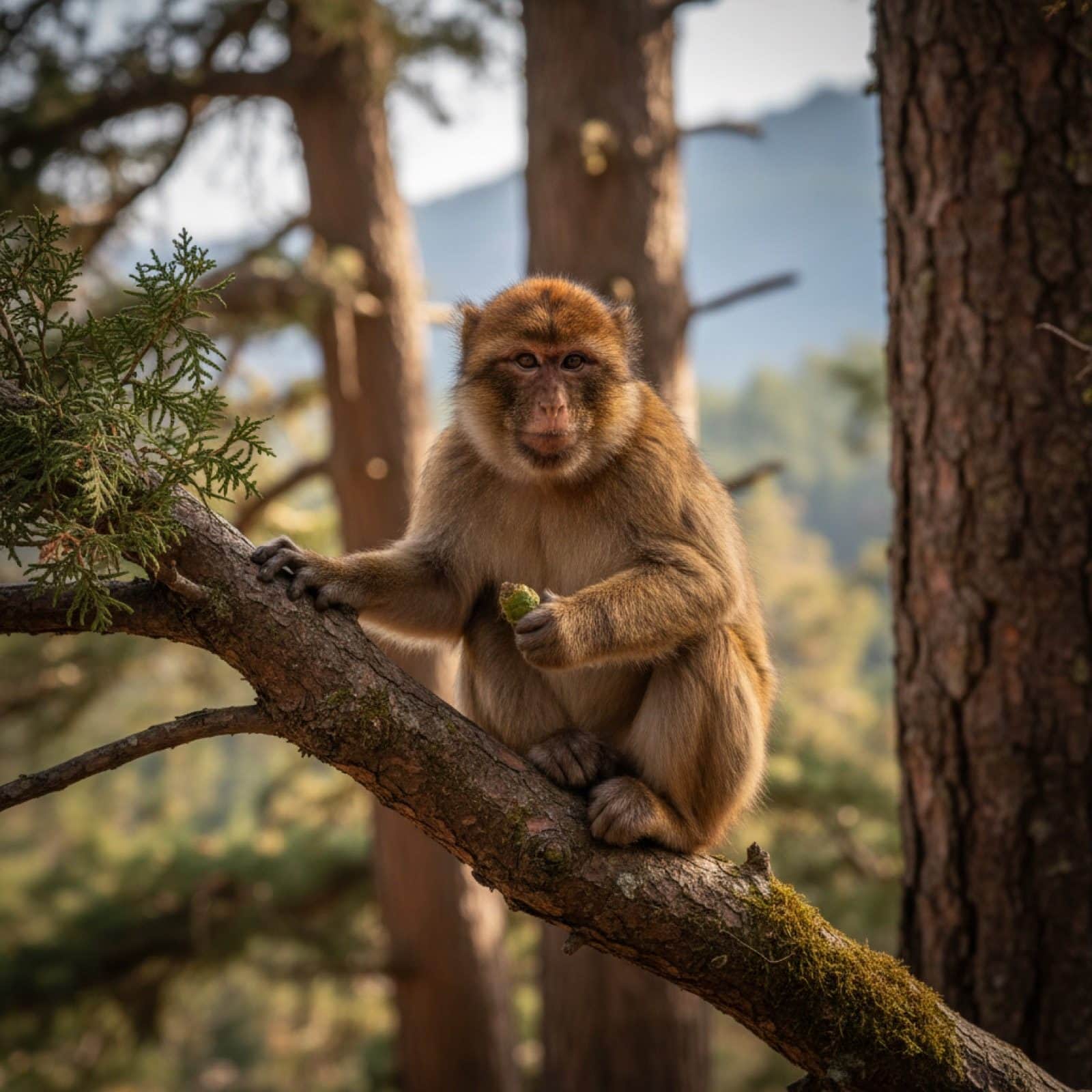
Morocco is a surprisingly rich wildlife destination — Barbary macaques in the Middle Atlas cedar, the rare Northern bald ibis on the Souss-Massa coast, dolphins and the last monk seals off the Atlantic Sahara, Strait of Gibraltar orcas and one of the world's great raptor migrations, plus flamingos and desert specialists. This pillar guide maps what you can really see, by region and season, and how to watch it ethically — without the chained macaques and snake charmers of the tourist circuit.
Morocco is one of the most underrated wildlife destinations in the Mediterranean basin — Barbary macaques in the Middle Atlas cedar forests, the rare Northern bald ibis on the Souss-Massa coast, dolphins and the last monk seals along the Atlantic Sahara, Strait of Gibraltar orcas, flamingos, and one of the planet's great raptor migrations. The trick is knowing where each lives and which season to go.
I'm Amina, and I plan and run wildlife trips here for a living. This is the pillar guide I wish existed when clients first ask me 'what animals will we actually see in Morocco?' It is organised the way wildlife really works — by habitat and region, not by wish list — and it is honest about what's reliable, what's rare, and what you should never pay to see. Ethical viewing is the spine of everything below, because in Morocco the difference between a good encounter and a cruel one is often a single decision at the roadside.
What wildlife can you actually see in Morocco?
In a single well-planned trip you can realistically see Barbary macaques, Greater flamingos, the Northern bald ibis, bottlenose dolphins, migrating raptors and storks, and a long list of birds — from desert larks to Atlas endemics. Big land mammals are gone.
That last sentence matters. Morocco no longer has wild Barbary lions (extinct in the wild by the mid-20th century), nor the wild Atlas bear. What you have instead is a remarkable cross-section of habitats packed into one country: snow-dusted cedar forest, Atlantic estuaries, Saharan steppe, high mountain, and a coastline that sits directly under the Europe–Africa flyway. That geography is why a place most people associate with souks and sand is, for a naturalist, genuinely thrilling. The headline residents are the Barbary macaque — the only macaque living outside Asia and the only wild primate in North Africa — and the Northern bald ibis, one of the rarest birds on Earth. Around them sits everything from flamingos to Moussier's Redstart, a redstart found nowhere but North Africa.
Where do you see Barbary macaques — and how do you do it ethically?
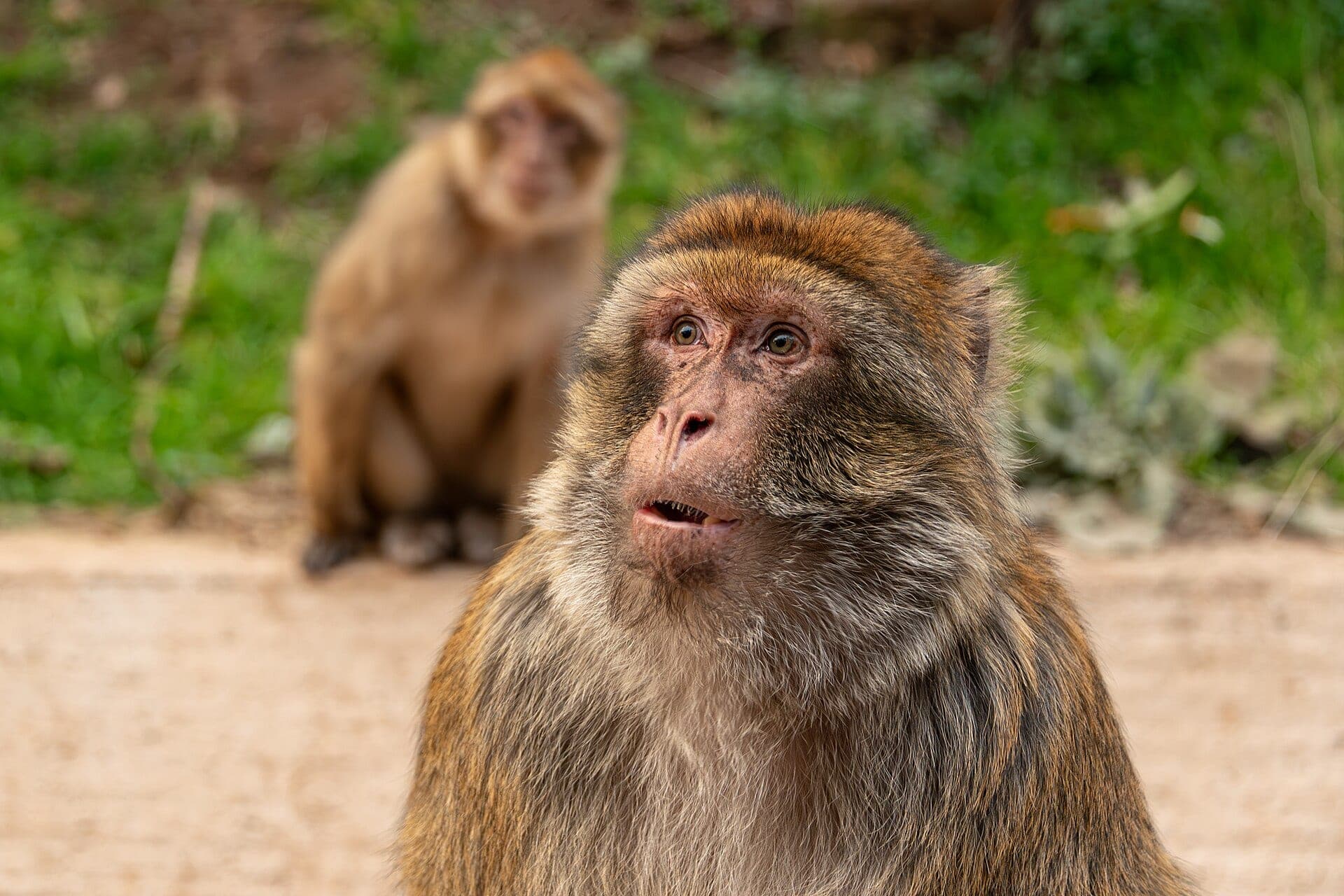
In the wild, free-ranging Barbary macaques live in the Atlas cedar forests near Azrou and Ifrane in the Middle Atlas. Watch them there, on their terms. Never photograph a chained 'photo monkey' on Jemaa el-Fna or feed roadside troops — both fuel real harm.
The Barbary macaque is listed as Endangered by the IUCN. Morocco holds the majority of the world's population, with the Middle Atlas cedar belt — Ifrane National Park and the forests around Azrou — its global stronghold; population estimates put the country's total in the low thousands, down sharply from far higher numbers in the 1970s. The threats are habitat loss, drought, and the infant pet-and-photo trade that supplies the chained animals you see touted in Marrakech. This is the cleanest example of the ethical fork in Morocco wildlife: pay a snake charmer or a monkey handler and you bankroll the trade; drive an hour into the cedar and you watch a wild troop forage for free. For the full do's-and-don'ts, our ethical guide to the Azrou Barbary macaques walks through exactly how to behave at the forest, and the guided version is the Barbary macaque ethical observation tour from Azrou.
Where can you see the Northern bald ibis in Morocco?
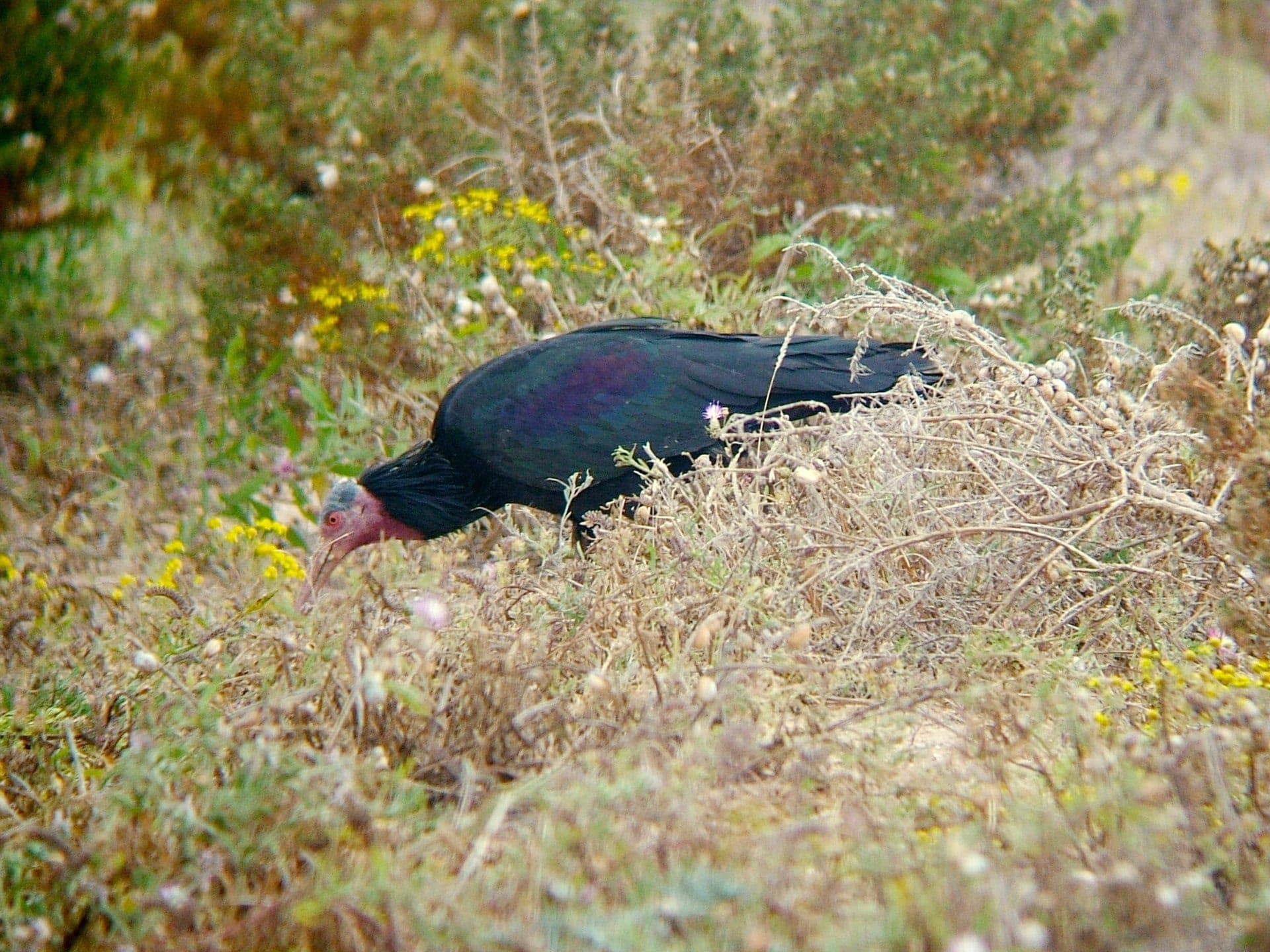
On the Atlantic coast near Agadir — at Souss-Massa National Park and the Tamri colony. Together they hold roughly 95% of the world's truly wild Northern bald ibis. It is the only place on Earth to reliably see a wild population of this prehistoric-looking bird.
The Northern bald ibis (Geronticus eremita) is a large, glossy-black bird with a bare red face and a long, down-curved bill — sacred in ancient Egypt, gone from Europe for over 300 years, and reduced by roughly 98% across the last century. Morocco saved it. Thanks to colony protection at Souss-Massa (about an hour south of Agadir) and Tamri (about 50 km north), the wild population recovered enough for the IUCN to downlist it from Critically Endangered to Endangered in 2018 — a rare good-news story in conservation. The non-negotiable rule is distance: never approach the breeding cliffs. Watch the foraging birds on the coastal grassland with binoculars. Full site-by-site detail is in where to see the Northern bald ibis in Morocco, and the four-day guided trip is the Northern bald ibis birding tour at Souss-Massa.
What marine wildlife lives off Morocco's coasts?
Plenty: bottlenose and common dolphins, pilot whales, flamingos in the Dakhla and Khnifiss lagoons, the famous Strait of Gibraltar orcas that follow bluefin tuna inshore each summer, and — far to the south on the remote Atlantic Saharan coast — the Critically Endangered Mediterranean monk seal.
Morocco's Atlantic coast runs nearly 3,000 km and crosses several marine worlds. In the far south, Dakhla Bay — a 40,000-hectare Ramsar lagoon at the edge of the Sahara — holds resident bottlenose dolphins, tens of thousands of wintering birds, and flamingos best seen November to March; it is also the last, nearly-lost home on this coast of the Critically Endangered Atlantic humpback dolphin, of which only a handful (perhaps one) may remain there. Monk seals occur along this remote Atlantic Saharan coast, in the wider Dakhla and Western Sahara region; the main surviving colony of the Mediterranean monk seal — the planet's most endangered seal, recently downlisted to Vulnerable after decades of recovery — sits at the Cap Blanc (Cabo Blanco / Ras Nouadhibou) peninsula at the far southern end of the coast, on the Western Sahara–Mauritania border. Our honest field guide to Dakhla's wildlife — flamingos, dolphins and the vanishing monk seal sets out what you can and can't expect on this coast.
Can you see orcas and dolphins in the Strait of Gibraltar?
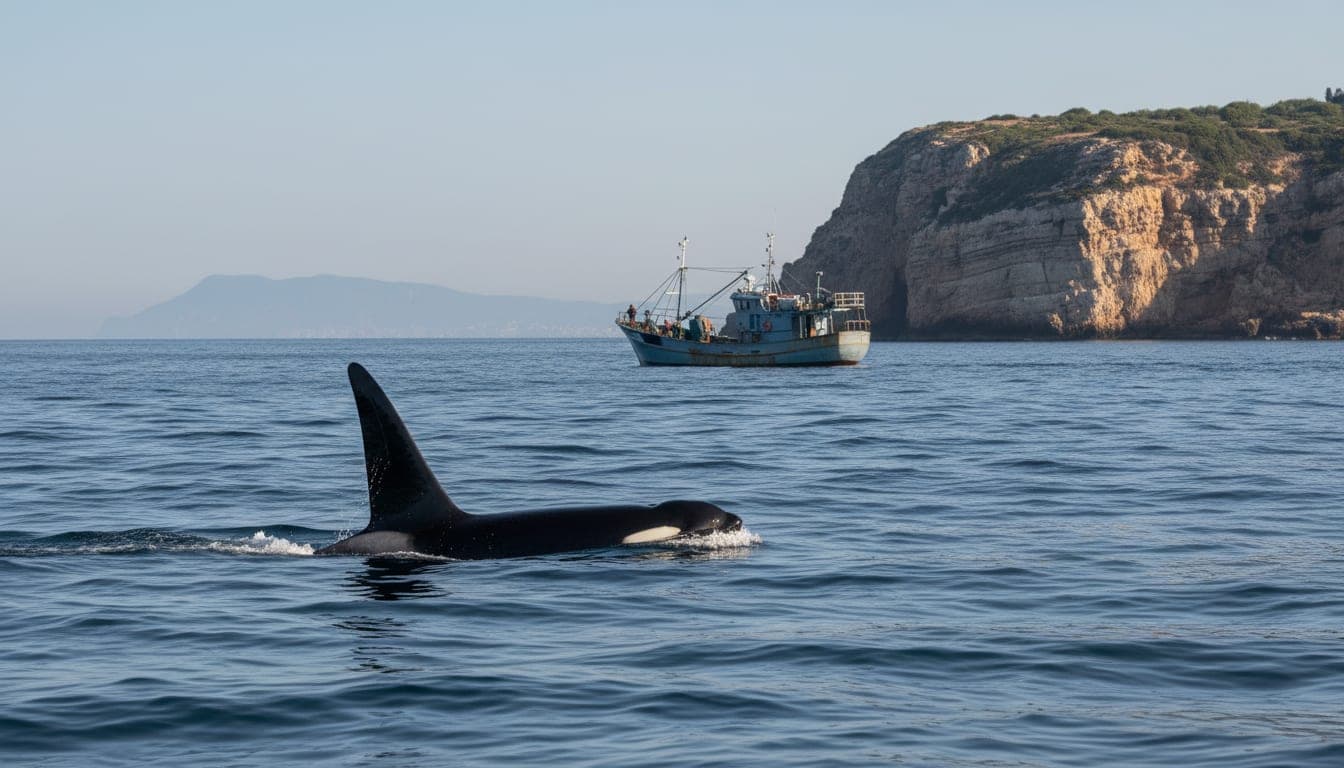
Yes. The Strait of Gibraltar, off Tangier and Tarifa, is one of Europe's best cetacean corridors — bottlenose, common and striped dolphins and pilot whales are seen much of the year, and a small population of orcas appears in summer following migrating bluefin tuna.
This narrow channel — barely 14 km at its tightest — funnels marine life between the Atlantic and the Mediterranean. The headline animal is the Iberian orca subpopulation, numbering only around 50 individuals and classed as Critically Endangered; the pods gather in the Strait in late spring and summer to hunt Atlantic bluefin tuna, which is why sightings cluster then. (These are the orcas behind the well-publicised interactions with sailing-boat rudders — a reminder that these are genuinely wild, pressured animals, not a show.) Pilot whales and several dolphin species are far more reliable across the season. From the Moroccan side you can combine a Strait cetacean trip with the limestone caves near Tangier — see Strait of Gibraltar orca watching from Tangier and the guided Strait cetacean and cave tour from Tangier.
Is Morocco good for birdwatching and the raptor migration?
Outstanding. The Strait of Gibraltar is one of the world's top five raptor-migration sites: each autumn roughly 250,000–300,000 birds of prey and around 150,000 storks pour across the narrow gap between Africa and Europe, on top of Morocco's resident and desert specialities.
Because most soaring birds avoid long sea crossings, they bottleneck at the Strait — so from late summer into October you can watch honey buzzards, black kites, short-toed and booted eagles, Egyptian vultures and storks stream overhead in their thousands. Spring reverses the flow, northbound. Away from the Strait, the Souss-Massa estuaries log 250+ species, the Merzouga and Sahara fringe hold desert specialists like the Desert Sparrow and Cream-coloured Courser, and the High Atlas adds the North African endemic African Crimson-winged Finch. For the full migration picture, read Morocco's bird migration at the Strait of Gibraltar; the guided version runs as the migration birding tour of the Strait and Atlantic estuaries.
What wildlife lives in the Sahara and on the desert fringe?
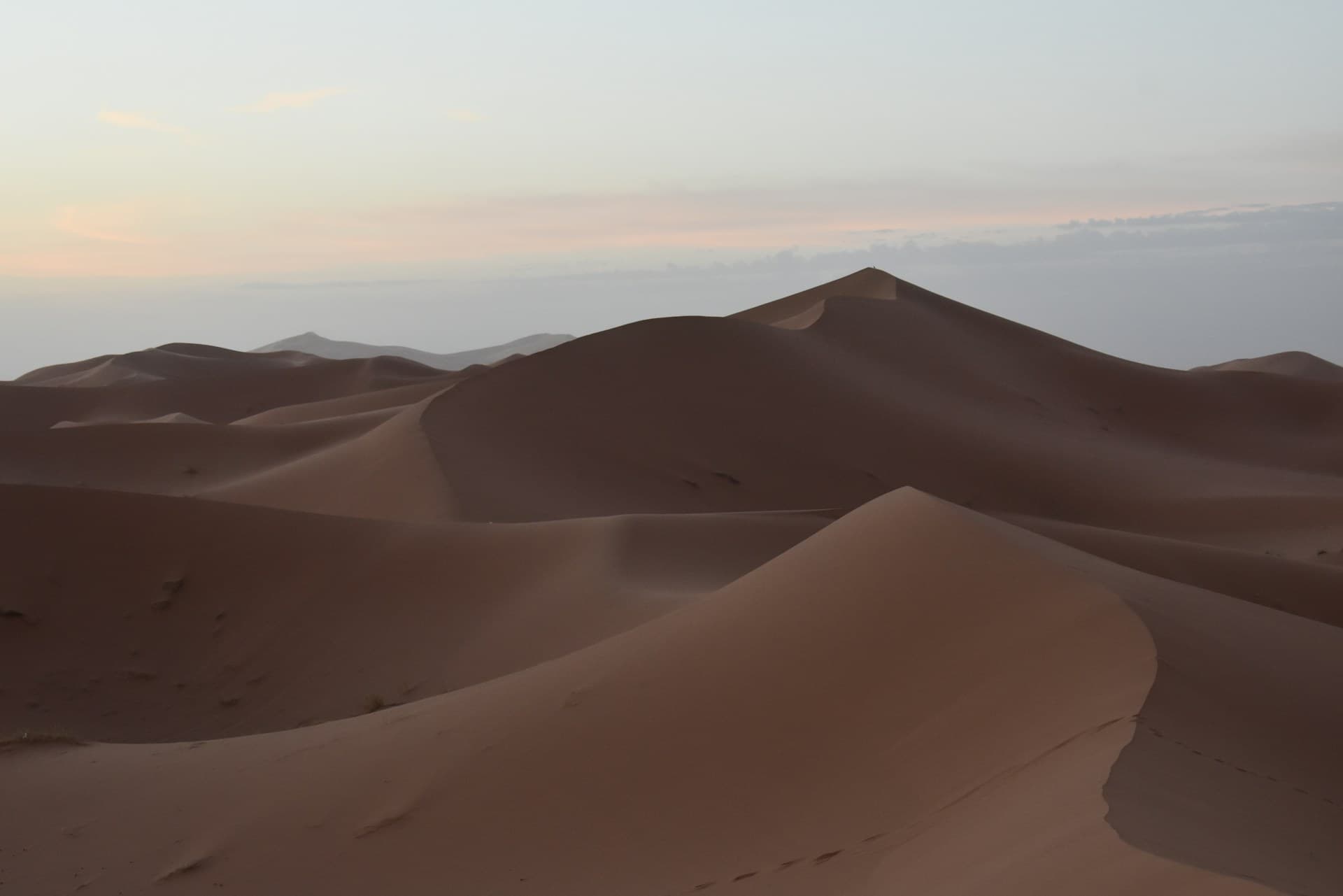
The desert is quieter than the coast but full of specialists: fennec fox, Saharan and sand foxes, jerboas, desert hedgehogs, gerbils, a range of reptiles, and reintroduced antelopes — scimitar oryx, addax and dama gazelle — held in protected reserves like Souss-Massa.
Most desert mammals are nocturnal and shy, so honest expectation matters: you are far more likely to find fennec tracks at dawn than a fennec posing in daylight, and any 'fennec photo' offered to tourists usually means a captured wild kit. The reliable desert wildlife is birds and reptiles — wheatears, larks, sandgrouse, agamas, and (with luck and respect) a horned viper trail in the dune sand. Morocco also runs serious reintroduction programmes: the scimitar-horned oryx, Extinct in the Wild for decades, is being bred and released in fenced reserves. None of this needs a captive 'desert zoo' stop — the real thing is out there for anyone willing to walk at the right hour with someone who knows the ground.
Which regions hold which wildlife — and when should you go?
Match the animal to its habitat and its season and your odds soar. The table below is the at-a-glance version I send clients before we build an itinerary — region, headline species, and the months that actually work for each.
| Region / habitat | Headline wildlife | Best season |
|---|---|---|
| Middle Atlas cedar (Azrou, Ifrane) | Barbary macaque, Levaillant's woodpecker, raptors | Apr–Jun, Sep–Oct (avoid deep winter snow) |
| Souss-Massa & Tamri coast (Agadir) | Northern bald ibis, flamingo, 250+ birds | Oct–Apr (ibis); Mar–May & Sep–Nov (migration) |
| Strait of Gibraltar (Tangier/Tarifa) | Migrating raptors & storks, dolphins, orcas | Aug–Oct (raptors); late spring–summer (orcas) |
| Dakhla & Atlantic Sahara coast | Flamingo, bottlenose dolphin, monk seal (far S) | Nov–Mar (flamingos, wintering birds) |
| Sahara fringe (Merzouga, Aousserd) | Desert birds, fennec, reptiles, reintroduced antelope | Oct–Apr (avoid summer heat) |
What wildlife encounters should you avoid in Morocco?
Avoid the staged 'attractions': chained Barbary macaques posed for photos, snake charmers and their defanged cobras on Jemaa el-Fna, captive fennec foxes, and any boat tour that guarantees a rare or endangered sighting. They are cruel, illegal in spirit, or simply false.
Here is the operator's blunt version. The macaques and cobras of Marrakech's main square are wild-caught animals; the snakes are often de-fanged or have their mouths sewn, and many die within months. Paying for a photo is paying for the next capture. The same logic applies to roadside monkey-feeding in the cedar (it makes troops aggressive and sick), to captive fennecs, and to any operator who 'promises' the humpback dolphin or the orca. Ethical viewing in Morocco isn't a vague nicety — it is the single biggest lever an ordinary traveller has on whether these species survive. Choose wild, keep your distance, and never reward a chain.
Do you need a guide to see Morocco's wildlife?
Not always — but for the rare species, yes. Macaques and Strait dolphins are findable independently; the Northern bald ibis, the desert specialists and the raptor migration reward a guide who knows the current sites, reads the weather, and enforces the no-approach ethic.
Wildlife shifts. The ibis foraging fields move; the orcas track tuna that track temperature; the raptor 'big days' depend on wind direction at the Strait. A good local guide turns a hopeful drive into a near-certain sighting and, just as importantly, keeps the encounter clean — distance kept, no baiting, no playback abuse, sensitive sites protected. That is exactly the standard we build our wildlife trips around. If you'd rather have it all assembled — the right region, the right week, a credentialed naturalist, and the ethics baked in — start with our trip planner and tell us which of these animals you most want to see.
In summary
Morocco is a genuinely rich wildlife country once you stop looking in the souk and start looking at the map. The cedar forests give you wild Barbary macaques; the Souss-Massa coast gives you the world's last wild Northern bald ibis; the Atlantic Sahara gives you flamingos, dolphins and the last monk seals; and the Strait of Gibraltar gives you orcas, dolphins and one of the planet's great raptor migrations. Go in the right season, watch from the right distance, and refuse the chained-animal trade — and you'll come home with the rarest thing of all: encounters that were real, and that you helped keep possible.

Written by
Amina Benkirane
Destination Editor
Writer and photographer covering the Maghreb. Ten years of wandering souks, kasbahs, and back roads most guidebooks miss.