A surf operator's honest guide to Morocco's Atlantic coast — Taghazout's point breaks, the Oct-Mar swell season, beginner beaches, water temps, board hire, and how it pairs with Essaouira.
“Taghazout, a former fishing village just north of Agadir, is Morocco's surf capital. It sits on a stretch of Atlantic coast lined with consistent right-hand point breaks, has a long season that runs roughly October to March, and the water stays warm enough to surf in a 3/2mm wetsuit most of the year. Beginners learn on the sandy beach breaks at Tamraght and Imsouane; experienced surfers come for Anchor Point and Killer Point. This guide breaks down the season, the spots by skill level, lessons and board hire, and how the surf coast pairs with windy Essaouira to the north.”
— Youssef El Alaoui — Lead Morocco Specialist at Morocco Beauty Spots, ten years on the coast
I have been running travellers up and down this coast for a decade, and the question I get most is simple: is Morocco actually a good place to surf, or is it hype? It is the real thing. The Atlantic faces straight into the low-pressure systems that spin across the North Atlantic all winter, and the coastline north of Agadir bends in a way that turns that raw swell into long, peeling point breaks. You get warm sun, cheap food, a 30-minute drive between world-class waves, and a season that runs while Europe freezes.
This is a guide written from the water, not a brochure. I will tell you when to come, where to go for your level, what it costs, and where it is honestly better to send a kitesurfer than a surfer. If you would rather skip the logistics entirely, we run a guided version of all of this — but read first, decide later.
When is the best time to surf in Morocco?
The best surf season in Morocco runs from October to March. That is when North Atlantic groundswell is most consistent, the point breaks switch on, and the famous rights start working. Summer is small and flat by comparison.
Here is the mechanism. From autumn into early spring, deep low-pressure systems track across the North Atlantic and fire clean, organised groundswell at the Moroccan coast. Those long-period waves wrap around the headlands north of Taghazout and produce the long, peeling point breaks the region is known for. December through February is the prime window for the big, hollow swells, while October-November and March give you slightly smaller, friendlier conditions that suit improving surfers. Summer (June-August) is the off-season for surf: the Atlantic goes quiet, the points rarely break, and the energy on this coast shifts to wind sports. If you are timing a wider trip, our guide to the best time to visit Morocco lines the surf season up against the rest of the country's seasons so you do not, for example, plan a Sahara leg in the August heat just to catch flat surf.
Why is Taghazout Morocco's surf capital?
Taghazout is Morocco's surf capital because it sits in the middle of the country's densest cluster of quality point breaks. Within a 30-minute drive you can reach mellow beginner beaches and several genuinely world-class waves, all sharing one base.
It started as a Berber fishing village and was discovered by travelling surfers in the 1960s and 70s, who came overland chasing the rumour of perfect rights. That history still shapes the town: it is small, walkable, full of surf shops, rooftop cafes and board-repair guys, and built entirely around the rhythm of the swell. The decisive thing is geography. North of Taghazout the coast turns in a series of rocky headlands, and each one peels a right-hander on the right swell — Anchor Point, Killer Point, Boilers, La Source. A few minutes south, the sandy bays at Tamraght and Banana give beginners a soft place to learn. Nowhere else in Morocco packs that range of waves into such a short drive, which is exactly why the camps, coaches and contests all cluster here rather than anywhere else on the 1,800-plus kilometres of Atlantic coast.
Where should beginners surf in Morocco?
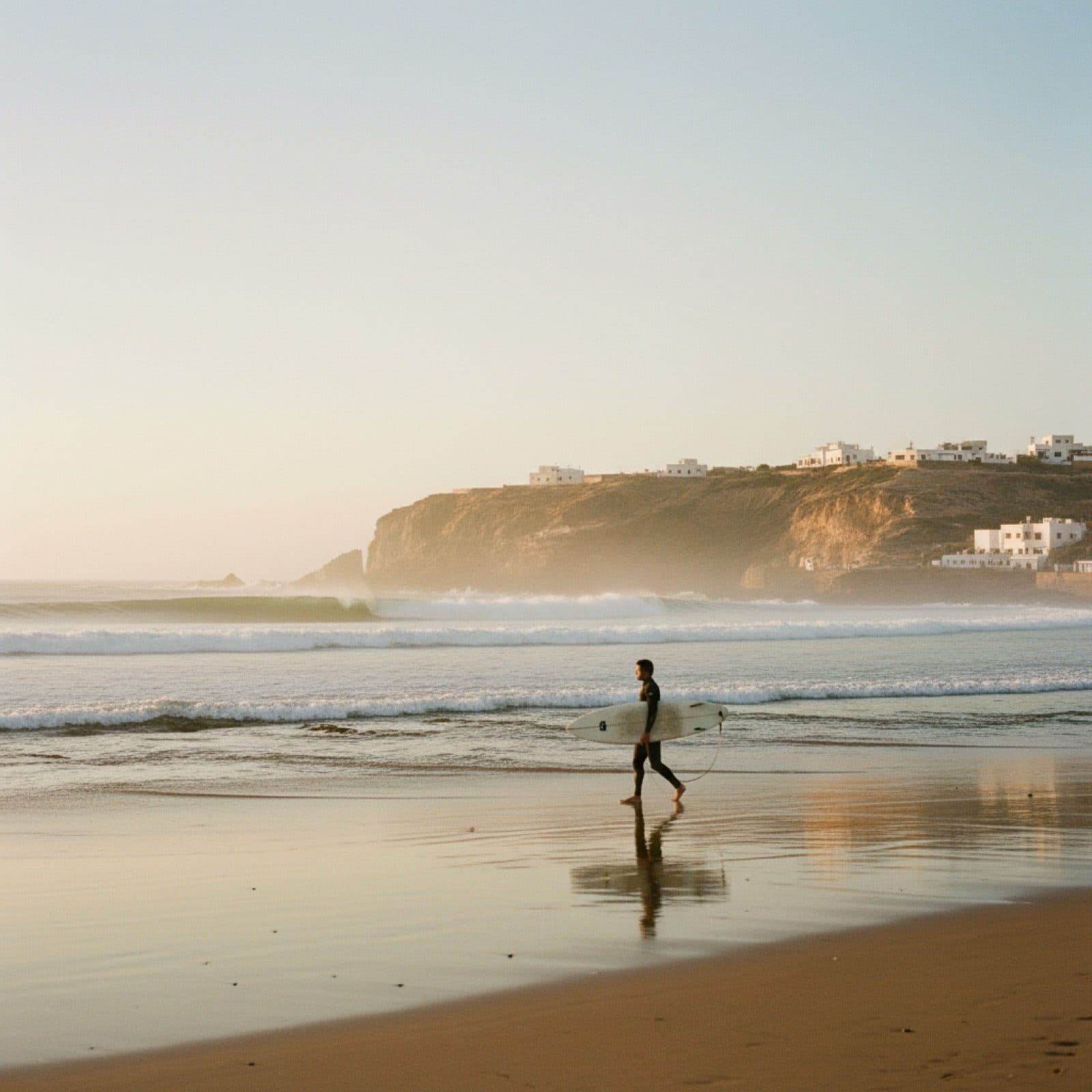
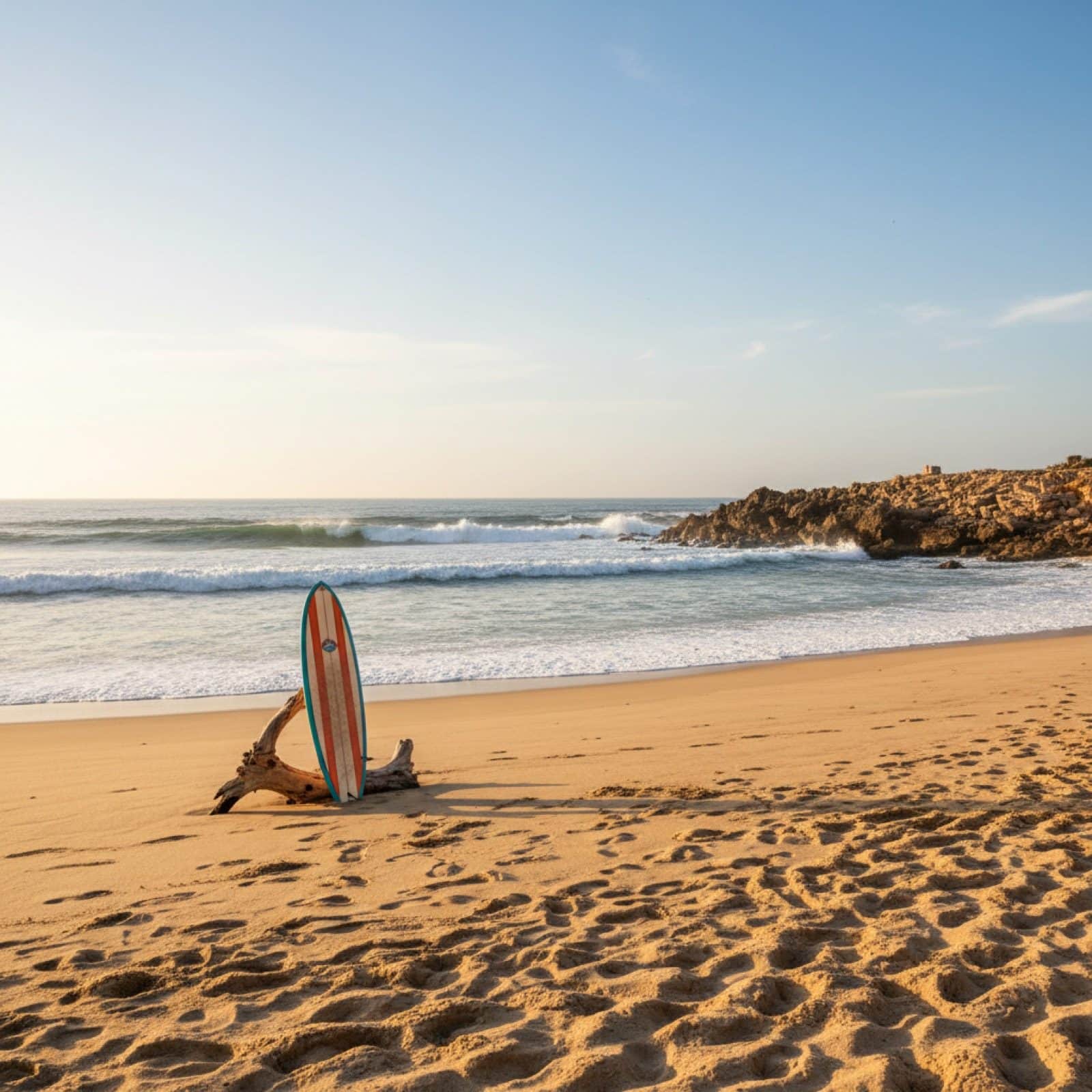
Beginners should surf the sandy beach breaks south of Taghazout — Tamraght, Banana Beach and Crocodile — plus the protected bay at Imsouane. These are forgiving sand-bottom waves with whitewater to practise on, not rocky reefs.
If it is your first week on a board, you do not belong at Anchor Point, and any honest coach will tell you so. The point breaks fire over rock shelves, hold strong currents, and are crowded with experienced surfers who will not appreciate a beginner drifting into the lineup. Instead, you want sand. Banana Beach (named for the palm grove behind it) and the wider Tamraght beach offer gentle, rolling whitewater that is perfect for popping to your feet. Crocodile, a little further down, is similar. These spots are where every reputable surf school runs its lessons, because the consequence of a wipeout is a mouthful of saltwater, not a reef cut. The other great beginner option is Imsouane, about an hour north — its main bay produces one of the longest, slowest, most forgiving waves in the country, so good for learning that intermediates ride it too just for the sheer length of the rides.
What are Morocco's world-class surf spots?
Morocco's headline waves are Anchor Point and Killer Point near Taghazout — long, fast right-hand point breaks — plus the exceptionally long right at Imsouane. Anchor Point is the most famous, peeling 300 to 500 metres over a rock shelf on a clean groundswell.
Anchor Point is the wave that put Morocco on the surf map. On a solid winter swell it walls up and runs for hundreds of metres along the rock shelf north of the village — it is the wave the World Surf League uses for its Pro Taghazout Bay qualifying-series event, which tells you the calibre. Killer Point (named for the killer whales sometimes seen offshore, not the wave's mood) is a powerful, longer-period right that handles bigger swell and is for confident intermediate-and-above surfers only. Boilers, breaking over rock near a shipwreck up the coast, is another heavy, high-quality right. And then there is Imsouane: not powerful, but astonishingly long — on the right day the bay gives you a slow, workable right wall that can run for several hundred metres, the kind of ride that lets you actually practise turns rather than just survive the drop. These are the waves people fly across continents for.
| Spot | Wave type | Best for | Notes |
|---|---|---|---|
| Tamraght / Banana Beach | Sand-bottom beach break | Beginner | Soft whitewater; where most lessons run |
| Crocodile | Beach break | Beginner | Gentle, sandy, forgiving wipeouts |
| Imsouane (the Bay) | Long right point | Beginner to intermediate | One of the longest, slowest rides in Morocco |
| La Source / Hash Point | Right point over rock | Intermediate | Good step-up before the heavier points |
| Anchor Point | Long right point break | Advanced | 300-500m peel; the iconic Morocco wave |
| Killer Point | Powerful right point | Advanced | Holds big swell; experienced surfers only |
| Boilers | Heavy right over rock | Advanced | Breaks near a shipwreck up the coast |
How warm is the water and what wetsuit do I need?
Atlantic water off Taghazout is cool but surfable year-round, sitting roughly 16-19°C in the winter surf season. A 3/2mm wetsuit is the standard choice; in the coldest mid-winter weeks some surfers prefer a 4/3mm for longer sessions.
This is the surprise for people who assume Morocco means tropical water. It does not. The Canary Current pulls cooler Atlantic water down this coast, so even with the sun blazing, the sea stays bracing rather than warm. Through the prime surf months you are looking at water in the mid-to-high teens Celsius — comfortable for a couple of hours in a 3/2mm full wetsuit, which is what almost everyone wears here. In the depths of winter, or if you feel the cold or surf long dawn sessions, stepping up to a 4/3mm keeps you out longer. You will not need boots or gloves. In late spring and early autumn the water warms a touch and a 3/2 is plenty. Any decent surf school or rental shop in Taghazout supplies wetsuits as standard, so you do not need to fly one in.
Should I book a surf camp or take individual lessons?
Surf camps suit social travellers and beginners who want everything bundled — accommodation, lessons, board, transport to whichever spot is working. Individual lessons or private coaching suit people who want flexibility, faster progress, or a quieter trip without the dorm-room crowd.
Taghazout and neighbouring Tamraght are full of surf camps, and for a first-timer they are an easy on-ramp: you turn up, and the camp handles the board, the wetsuit, the daily call on which beach has the best conditions, and the lift there. They are sociable and good value, typically running as multi-day packages. The trade-off is that you surf on the group's schedule and at the group's level. If you are an improving surfer who wants to actually progress — or a couple or family who would rather not share a minibus with a stag party — private or small-group coaching gets you more water time, video review, and a coach reading the lineup for you specifically. That is the model we use on our guided trips: licensed coaches, small numbers, riad basing rather than a backpacker dorm. Whichever route you pick, insist the school is registered and the instructors are properly qualified before you hand over money.
How much does surfing in Morocco cost?
Surfing in Morocco is inexpensive by European or American standards. As an approximate guide, a group lesson runs in the region of 25-45 euros, a day's board-and-wetsuit hire around 10-20 euros, and a week-long surf-camp package with accommodation and tuition often falls somewhere between 350 and 700 euros depending on standard.
Treat those as ballpark figures, not quotes — prices move with the season, the standard of accommodation, and how much one-to-one coaching is included, and the cheapest hostel packages sit well below the premium-camp end of the range. What makes Morocco such good surf value is everything around the surfing: a plate of fresh grilled fish at the harbour, a rooftop coffee, a clean room within walking distance of the break — all cost a fraction of what you would pay in Portugal, France or California for comparable waves. Board hire is cheap enough that travelling without your own board is the sensible default for most people; you avoid airline board fees and can swap between a soft-top for the beach breaks and a shortboard for the points. If you want a sense of how surf prices fit into a wider Moroccan budget, our overview of whether Morocco is expensive puts the numbers in context.
How does the surf coast pair with Essaouira and kitesurfing?
Essaouira, up the coast toward Marrakech, is Morocco's wind capital rather than a surf town. Its near-constant Atlantic trade wind — the Alizés, blowing most of the year — makes it world-class for kitesurfing and windsurfing, while Taghazout to the south is the dedicated surf base.
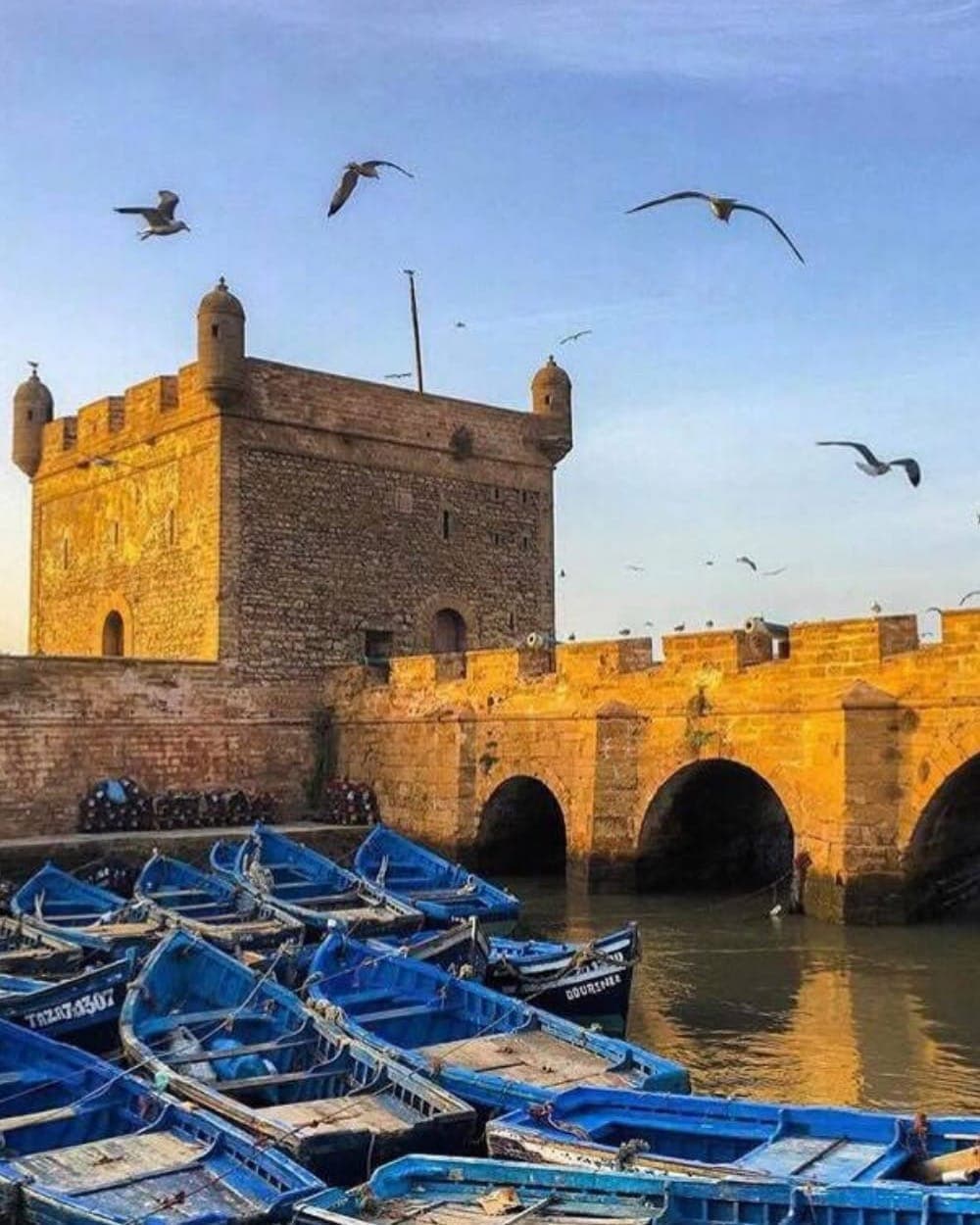
It is worth understanding the split, because travellers often lump the whole coast together. The same Atlantic that delivers clean surf swell to Taghazout also delivers relentless side-shore wind to Essaouira, and that wind is the enemy of good surf but the lifeblood of kite and windsurfing. So the coast naturally divides: come to Taghazout and Imsouane to surf waves; go to Essaouira and the gusty point at Moulay Bouzerktoun, just north of it, to fly a kite. The fortified port town itself is a destination in its own right — ramparts, Gnawa music, the freshest sardines in Morocco — and many travellers do both, surfing the south then heading north for wind and culture. Our deep-dive on Essaouira's wind, waves and Gnawa covers that side of the coast properly, and the windy, cooler town pairs naturally with Marrakech three hours inland.
Is Morocco good for a surf-and-culture trip?
Yes — Morocco is unusually good for combining surf with culture, because the waves sit so close to imperial cities, mountains and the desert. You can surf Taghazout in the morning and be in the souks of Marrakech, or the foothills of the High Atlas, the same day.
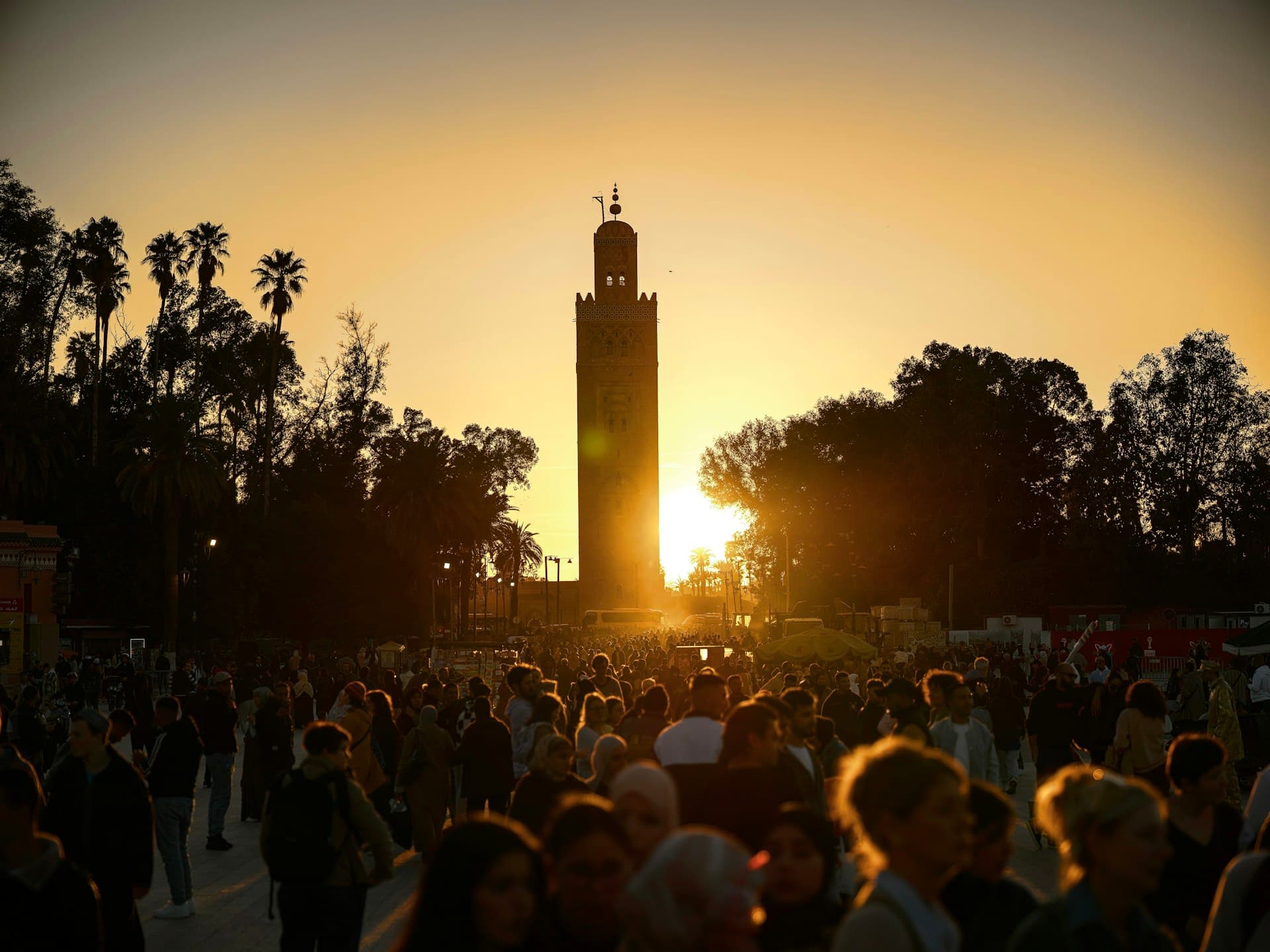
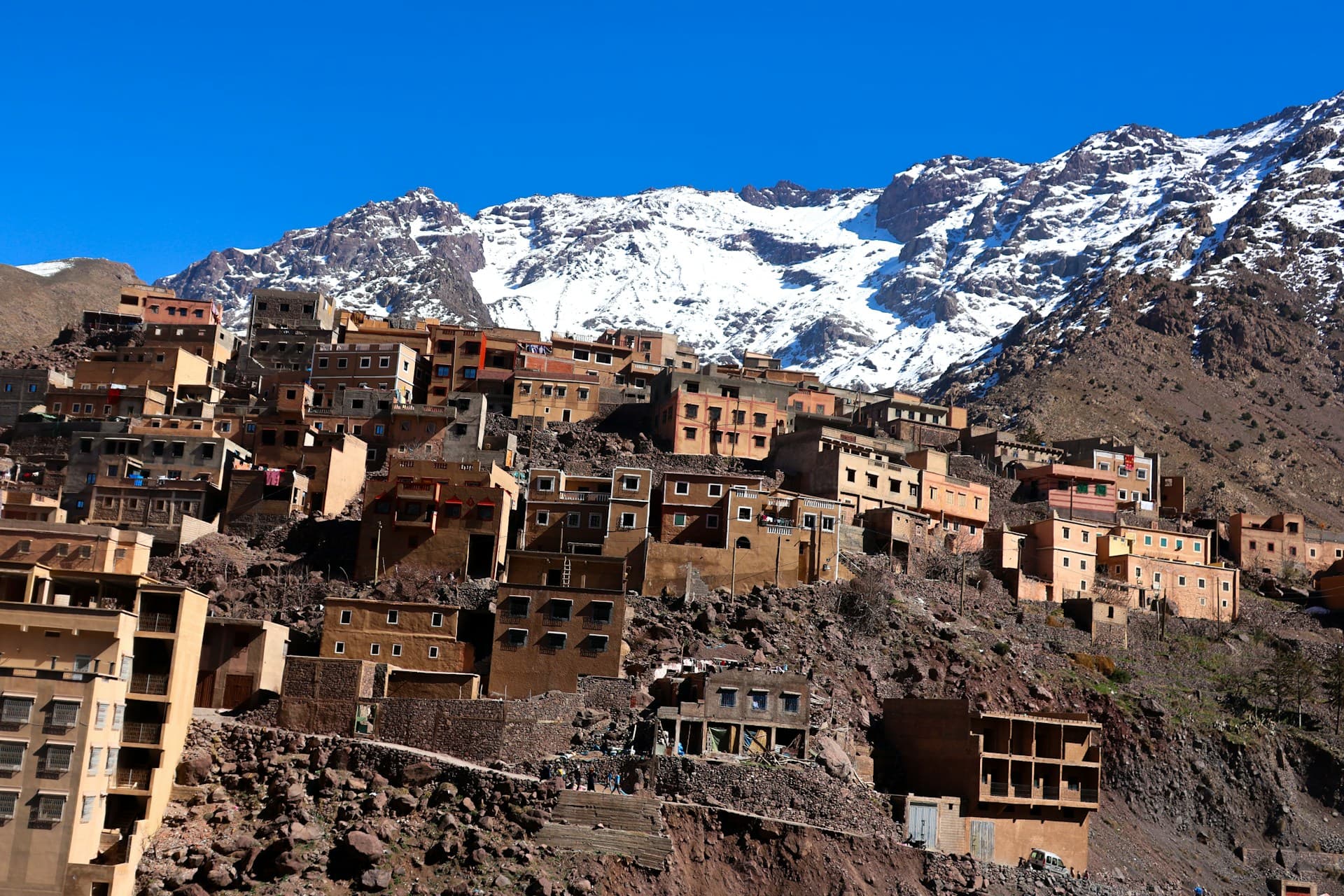
This is the part that makes Morocco different from a pure surf destination like the Mentawais or a stretch of Portuguese coast. The surf is genuinely world-class, but it is also a 2.5-hour drive from Marrakech, a short hop from the Anti-Atlas mountains and the almond valleys around Tafraoute, and within a day's reach of the Sahara's edge. That means a trip does not have to be surf-only. Plenty of our travellers want three or four days of waves bookended by a couple of nights in a riad, a mountain day, or a desert finish — surf in the morning, mint tea and a thousand-year-old medina by evening. The coast also rewards a slower pace: grilled-sardine lunches at fishing harbours, argan-oil cooperatives in the hills behind the beach, and sunsets over the Atlantic that have nothing to do with the surf forecast.
In summary: where to surf in Morocco
In summary, Taghazout north of Agadir is Morocco's surf heart: come October to March for the consistent point-break swell, learn on the sandy beaches at Tamraght and the long bay at Imsouane, and graduate to Anchor Point and Killer Point as your surfing allows. Pack — or rent — a 3/2mm wetsuit for the cool Atlantic, expect prices well below Europe, and remember that windy Essaouira up the coast is for kiters, not surfers. It is one of the rare places where genuinely good waves sit a short drive from imperial cities, mountains and the desert, which is why it works as well for a mixed trip as for a hardcore surf week.
If you would rather have the swell-reading, the spot choice and the logistics handled for you, our guided Atlantic Surf and Kite trip runs the Taghazout points in winter with private coaching and small numbers — the same coast in this guide, without the guesswork. Or if you want surf folded into a wider Morocco route with mountains, medinas or desert, tell us your level and your dates through the trip planner and we will build the week around the waves you can actually ride.
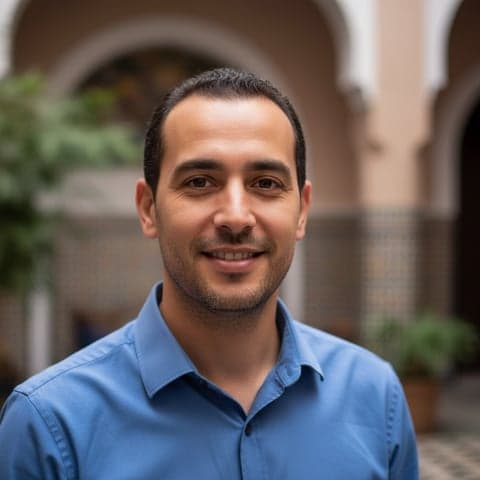
Written by
Youssef El Alaoui
Lead Morocco Specialist
Born in Fes, based in Marrakech. Designs private itineraries for Morocco Beauty Spots and still argues mint tea is best in the Atlas.