This Jewish Morocco tour follows a presence that is mostly gone and nowhere absent. Seven private days move from Casablanca to Essaouira to Fes, through synagogues kept lit, mellahs half-emptied, and white cemeteries on the hillsides — the quiet geography of a community that numbered roughly 250,000 in 1948 and a few thousand today. You walk slowly. The point is not to count what was lost but to sit inside what remains.
Morocco holds this memory more openly than anywhere else in the region. Casablanca's Museum of Moroccan Judaism, founded in 1997, is the only Jewish museum in the Arab world — its building opened in 1948 as an orphanage that sheltered as many as 160 Jewish children. In Essaouira, the old port of Mogador where Jews were once close to 40 percent of the population, the restored Bayt Dakira ("House of Memory") was reopened by King Mohammed VI in January 2020; it contains the Slat Attia synagogue and the Haim & Celia Zafrani research center on Jewish-Muslim relations. We pace these two places across separate days because they reward stillness, not a checklist.
Fes is where the morocco mellah tour has its deepest roots. The Fes mellah, established in 1438, was the first walled Jewish quarter in the country — the word mellah, "salt," attached itself to every Jewish quarter after. In Fes el-Jdid you enter the Ibn Danan synagogue, built in the 17th century by the merchant Mimoun Ben Sidan, placed on the 1996 World Monuments Watch and reopened in 1999 after a restoration funded with American Express and the Ministry of Culture; it is often described as the only fully intact historic synagogue left in Morocco. The hillside cemetery of white tombs below the mellah, repainted in 2019, holds more revered rabbis than any other in the country. A half-hour south lies Sefrou, once a third Jewish, the "Little Jerusalem" where Clifford Geertz did his fieldwork.
Be clear about what this is and is not. Several of these sites are intimate — Ibn Danan seats a few dozen; some Sefrou synagogues are ruins behind a custodian's key. Photography is restricted inside active prayer spaces, and Saturday access is limited by Shabbat. This is a heritage and study route, not a kosher-catered group pilgrimage, though we can align the dates with the September Pinto Hiloula if you want the synagogues full and singing rather than quiet.
You travel privately throughout, with a driver for the road and a specialist guide for the synagogue and mellah days — someone who can read a Hebrew foundation stone, explain why the cemetery moved overnight when the Sultan expanded his palace, and tell you which families still hold the keys. We finish in Fes. An optional eighth-day extension reaches the Marrakech mellah and the Miara cemetery for travelers who want the southern chapter as well.
- Museum of Moroccan Judaism in Casablanca — the only Jewish museum in the Arab world, founded 1997 in a 1948 building that once sheltered 160 Jewish orphans
- Bayt Dakira ("House of Memory") in the Essaouira medina — restored riad reopened by King Mohammed VI in January 2020, holding the Slat Attia synagogue and the Haim & Celia Zafrani research center
- Chaim Pinto synagogue, home of the rabbi (1748–1845) whose Hiloula draws 2,000+ pilgrims to Essaouira each September
- Ibn Danan synagogue in Fes el-Jdid — built in the 17th century, listed on the 1996 World Monuments Watch, reopened 1999; often called the only fully intact Moroccan synagogue
- The Fes mellah, established in 1438 — the first walled Jewish quarter in Morocco — and its hillside cemetery of white tombs, restored in 2015
- Sefrou, the town once a third Jewish and nicknamed "Little Jerusalem," studied by anthropologist Clifford Geertz
- Optional half-day in the Marrakech mellah (founded 1557) and the Miara cemetery, the largest Jewish burial ground in Morocco
- A specialist guide for the synagogue and mellah days — not a generalist driver — so the inscriptions, registers, and lineages are read, not glanced at
Day by day
- Day 1
Casablanca — Museum of Moroccan Judaism
Airport pickup at Casablanca Mohammed V. Afternoon at the Museum of Moroccan Judaism in the Oasis quarter — the only Jewish museum in the Arab world, founded in 1997 in a building that opened in 1948 as an orphanage for up to 160 Jewish children. Its rooms hold Torah scrolls, embroidered wedding kaftans, and synagogue fittings rescued from communities that emptied in the 1950s and 60s. A first, grounding read of the whole story before we go to the places themselves.
Stay overnight
- Day 2
Casablanca → Essaouira
Coastal drive south-west to Essaouira — the walled port the Jews knew as Mogador, where in the 19th century they were close to 40 percent of the population and ran much of the trans-Saharan trade through the sultan's royal merchants, the tujjar al-sultan. Evening to settle into the medina and the Atlantic wind. About 6 hours on the road with a lunch stop.
Drive · 6h
- Day 3
Essaouira — Bayt Dakira, Pinto synagogue & the mellah
A full slow day in the old Jewish quarter. Morning at Bayt Dakira ("House of Memory"), the restored riad reopened by King Mohammed VI in January 2020, holding the Slat Attia synagogue and the Zafrani research center. Then the Chaim Pinto synagogue, kept as the home of the rabbi who died in 1845 and whose September Hiloula still draws over 2,000 pilgrims. Afternoon walking the mellah lanes — fading Hebrew above doorways, the old skala fortifications, the gulls. Time left simply to sit.
Stay overnight
- Day 4
Essaouira → Fes
The long transit day, north and inland across the Tadla plain to Fes, the spiritual capital. We use the hours for context — recordings of Judeo-Arabic and the matrouz repertoire, the timeline from the 1438 mellah to the 1956 independence that began the great departure. Arrive Fes by evening; overnight in a riad near the medina. About 7 hours of driving with two stops.
Drive · 7h
- Day 5
Fes el-Jdid — Ibn Danan synagogue, mellah & cemetery
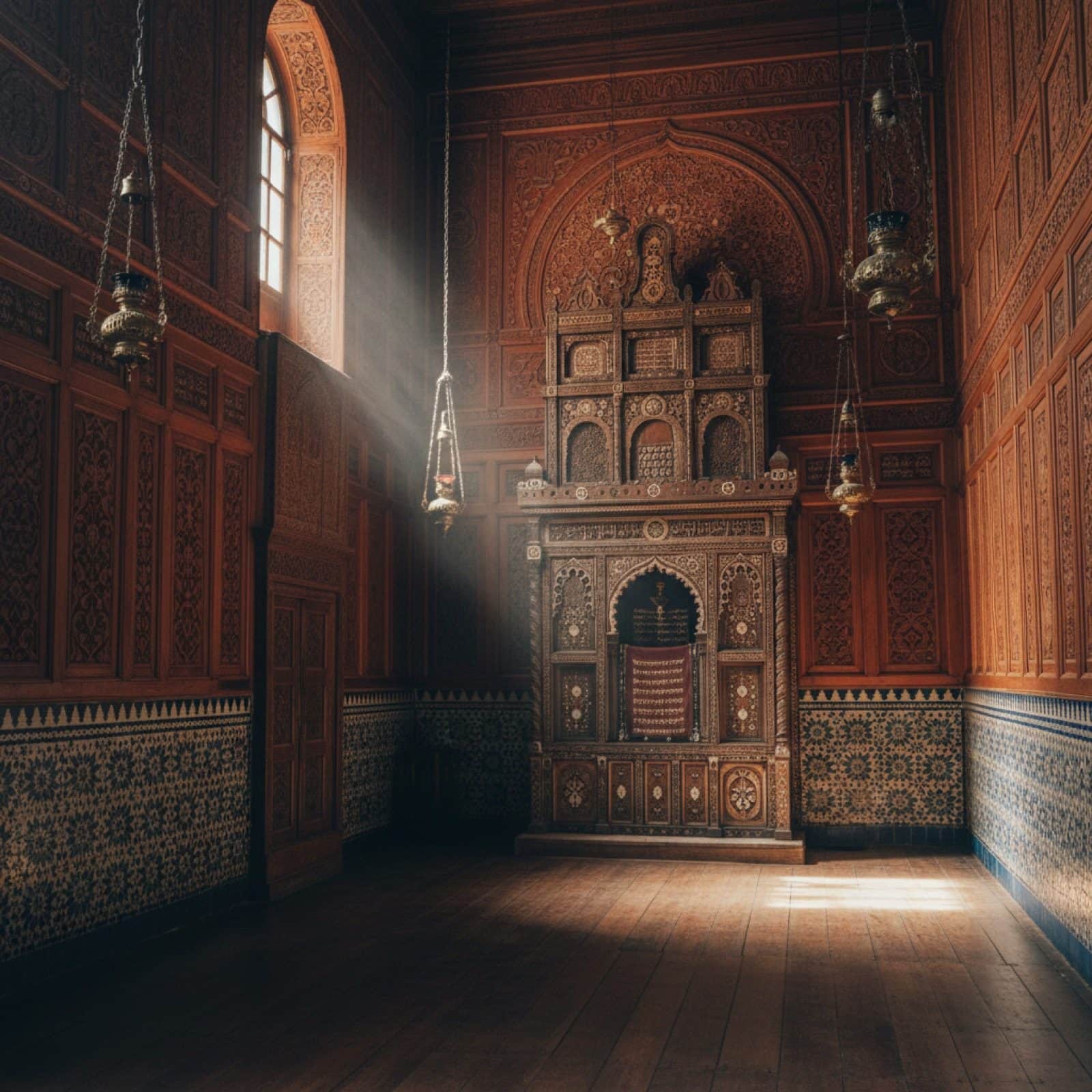
The heart of the route, with a specialist guide. The Fes mellah, established in 1438, was the first in Morocco; we read its balcony-fronted houses, unusual for an Islamic city. Inside the Ibn Danan synagogue — built in the 17th century, on the 1996 World Monuments Watch, reopened 1999 — you see the painted ark, the sunken mikveh, and the only fully intact historic prayer hall left in the country. Below, the hillside cemetery of white tombs, restored in 2015; your guide explains why it was moved overnight when Sultan Moulay Hassan expanded his palace.
Stay overnight
- Day 6
Fes & Sefrou — "Little Jerusalem"
A half-hour south into the foothills to Sefrou, the town once roughly a third Jewish, nicknamed "Little Jerusalem" and made famous to scholars by Clifford Geertz's 1960s fieldwork. We walk its mellah — among the largest in Morocco relative to the town — past Stars of David carved over lintels and the ruins of synagogues kept by a custodian's key. Back in Fes for a final evening; if you came for the September Pinto Hiloula we time this week to it.
Stay overnight
- Day 7
Fes — departure (optional Marrakech extension)
A quiet last morning in the Fes medina, then transfer to Fès–Saïss airport or onward train. Travelers taking the optional extension continue south to the Marrakech mellah, founded in 1557, and the Miara cemetery — the largest Jewish burial ground in Morocco, its whitewashed tombs dating from the 16th century — adding a day to the route.
End of journey
What's included
- 6 nights in characterful riads and hotels (Casablanca, Essaouira, Fes), mid-range to boutique
- Private vehicle with English-speaking driver for the full route
- Specialist Jewish-heritage guide for the Essaouira and Fes/Sefrou days
- All site entries — Museum of Moroccan Judaism, Bayt Dakira, Ibn Danan synagogue, mellah and cemetery access
- Daily breakfast and two heritage-context dinners
- Airport pickup and final-day transfer to airport or train
Not included
- International flights to and from Morocco
- Lunches and most dinners (Essaouira and Fes have strong options we'll recommend)
- Travel insurance — recommended; we can suggest HeyMondo or SafetyWing
- Optional 8th-day Marrakech mellah and Miara cemetery extension (priced on request)
- Personal purchases, tips, and Shabbat-meal arrangements if requested
- Jewish population, 1948 vs today
- ~250,000 then; a few thousand now
- Museum of Moroccan Judaism
- Founded 1997 — only Jewish museum in the Arab world
- Fes mellah established
- 1438 — the first in Morocco
- Ibn Danan synagogue
- 17th c.; reopened 1999 after WMF-listed restoration
“People expect grief on this route, and there is some. But the thing that stays with travelers is how unbroken the keeping is — a custodian in Sefrou who still has the synagogue key, the lamps Mohammed VI ordered relit at Bayt Dakira, the white tombs repainted by hand every few years. Morocco did not erase its Jews. It remembers them out loud. We just walk you slowly enough to hear it.”
What past travellers say

Sophie & Marc
Paris, France
“The best trip of our lives. Our guide knew every village, every viewpoint, every hidden riad. Seven days in Morocco felt like a month somewhere else.”

James H.
London, UK
“Everything was seamless from landing in Fes to the Sahara camp and back to Marrakech. The night under the stars is something I'll never forget.”

Ana Rodrigues
Lisbon, Portugal
“Organized, warm, professional. They built the itinerary around what we loved and gave us complete freedom to stop anywhere along the way.”
Read these first if you're still researching
The Vanished Mosaic — A Jewish Morocco Tour — frequently asked
- What does a Jewish Morocco tour actually cover in 7 days?
- This route covers Casablanca's Museum of Moroccan Judaism, Essaouira's Bayt Dakira and Chaim Pinto synagogue and mellah, and Fes el-Jdid's Ibn Danan synagogue, 1438 mellah, and hillside cemetery, plus Sefrou, the town once called "Little Jerusalem." An optional eighth day reaches the Marrakech mellah and Miara cemetery. It pairs sacred sites with the social history behind them.
- Why is Morocco's Jewish heritage so well preserved compared to the rest of the region?
- Morocco protected its Jews under King Mohammed V during World War II and has restored Jewish sites at the royal level since. Casablanca holds the only Jewish museum in the Arab world (founded 1997), King Mohammed VI personally reopened Essaouira's Bayt Dakira in January 2020, and the 2011 constitution recognizes a "Hebraic" strand in national identity. This morocco jewish heritage is treated as part of the country's own story.
- What is a mellah?
- Mellah means "salt" in Arabic and is the name for a Jewish quarter in a Moroccan city. The first was established in Fes in 1438, a walled district beside the royal palace; the name then spread to every Jewish quarter, including Marrakech (1557) and dozens of smaller towns. A morocco mellah tour reads these quarters as living urban archives — distinctive balconied houses, Hebrew lintels, and synagogue doorways.
- Can I visit the Ibn Danan synagogue in Fes, and what makes it important?
- Yes — it is open to visitors. Built in the 17th century by the merchant Mimoun Ben Sidan, it was placed on the 1996 World Monuments Watch and reopened in 1999 after a restoration backed by American Express and Morocco's Ministry of Culture. It is widely described as the only fully intact historic synagogue left in Morocco, with its painted ark, sunken mikveh, and original fittings preserved.
- When is the Chaim Pinto Hiloula in Essaouira?
- The Hiloula honoring Rabbi Chaim Pinto (1748–1845) falls around 26 Elul in the Hebrew calendar — usually mid-September — and runs roughly four days, drawing more than 2,000 Jewish pilgrims from around the world to his tomb and the Essaouira jewish quarter. We can time the tour to coincide if you want the synagogues full and singing; it must be booked well in advance.
- Is it respectful and safe to travel a Jewish heritage route in Morocco today?
- Yes. Morocco is among the safest countries in the region and treats its Jewish past as national heritage; sites are guarded and welcoming. Be respectful in active prayer spaces — modest dress, photography only where permitted, and limited access on Saturdays for Shabbat. Our specialist guides are versed in the etiquette and coordinate with site custodians ahead of each visit.
- How does this differ from a standard Morocco imperial-cities tour?
- A classic tour passes mellahs as a 20-minute photo stop. This morocco jewish history route slows down — a specialist guide reads the foundation stones, cemetery registers, and family lineages; days are paced for synagogues and museums rather than monuments. It trades breadth of landscape for depth in one thread of the country's past, which suits returning or study-minded travelers.
- Can the tour be kosher or Shabbat-observant?
- Yes, with advance notice. We can arrange kosher catering where available (strongest in Casablanca and Marrakech, which have active communities and supervised kitchens), plan the itinerary around Shabbat, and book accommodation within walking distance of an active synagogue. Tell us your level of observance at booking and we build the week around it.