The best riad in Marrakech isn't the highest-rated one — it's the one matched to you. An operator's honest guide to choosing by quarter, rooftop, pool, transfer help, and breakfast, not stars.
The best riad in Marrakech is the one matched to you — not the highest-rated. Choose on quarter and location, rooftop, plunge pool, transfer-and-luggage help, breakfast, and size — in that order. Star ratings barely apply to riads; fit does.
We place guests in Marrakech riads every week, and the pattern is always the same: the booking that goes wrong is almost never a bad riad. It's a lovely riad in the wrong spot, or one whose owner didn't explain that a taxi can't reach the front door. This is a how-to-choose guide, written by people who do this for a living — not a sponsored top-ten. By the end you'll know which features actually matter, which red flags to walk away from, and whether a riad even suits the way you travel.
What exactly is a riad, and how is it different from a hotel?
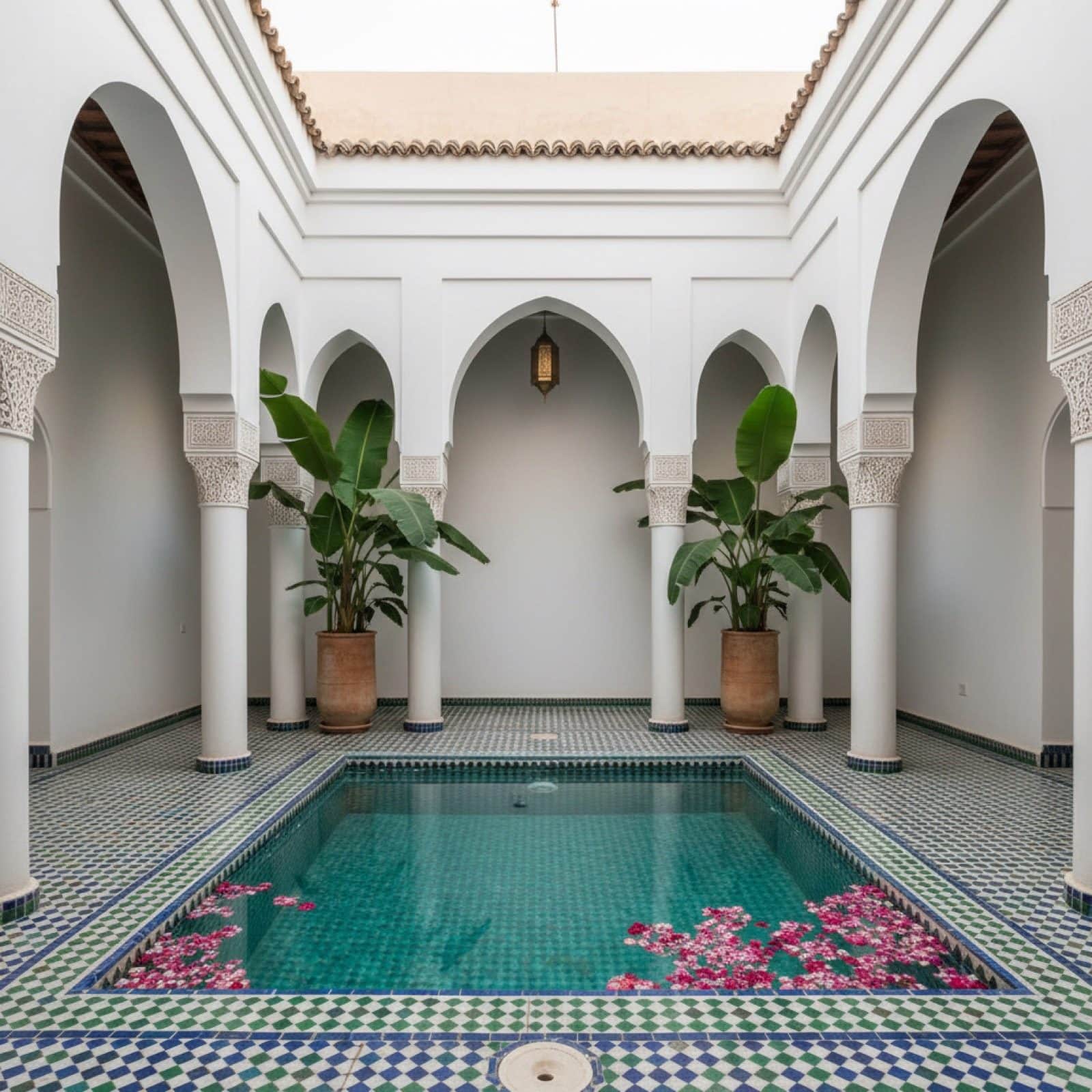
A riad is a traditional Moroccan house built inward around a central courtyard or garden — the word riad comes from the Arabic for garden. Rooms face the courtyard, not the street, for privacy, shade, and cool air.
That single architectural fact shapes everything about the stay. Because riads turn their backs to the alley, they're quiet and private inside even when the medina roars outside. They're small — often 4 to 10 rooms — so service is personal and you're hosted, not processed. Most are converted historic homes, so character runs high but standardisation runs low: room sizes, light, and noise vary wildly within the same property. Expect thick walls, tiled courtyards, a fountain or plunge pool at the centre, and a rooftop terrace. What you usually don't get is a lift, a big lobby, a gym, or step-free access. If you want the romance of staying inside a centuries-old medina home, a riad is the only way to do it. If you want predictable, full-service uniformity, that's a hotel — and we cover that trade-off in detail in our riad vs hotel in Morocco guide.
Which Marrakech medina quarter should you stay in?
Quarter is the single most important choice — more than the riad itself. The medina is a dense, walled, mostly pedestrian old town, so the question is really how much buzz versus calm you want, and how far you're willing to walk from the nearest taxi drop.
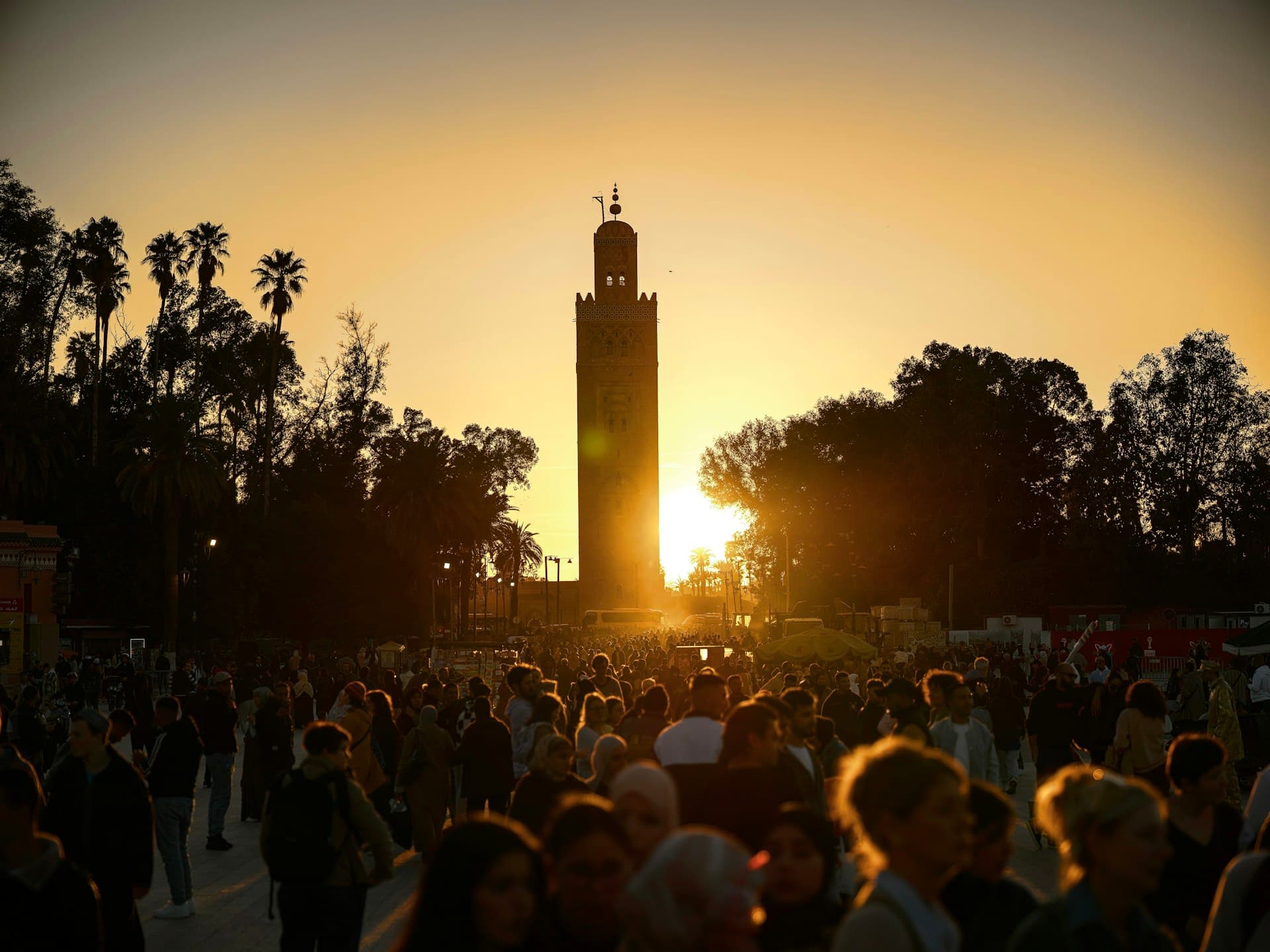
Near Jemaa el-Fnaa and the central souks (the Riad Zitoun and Kennaria areas) you get the beating heart of the city on your doorstep — food stalls, snake charmers, energy until midnight — but also noise, crowds, and persistent hustle. Mouassine and the northern souks sit a notch calmer, artisan-rich, and beautiful, still walkable to everything. Dar el Bacha and the Bab Doukkala side feel residential and elegant, popular with returning visitors who've had enough of the crush. The Kasbah quarter in the south, near the Saadian Tombs and Bahia Palace, is quieter and more spacious, an easy fit for families and slower travellers. First-timers torn between buzz and calm should read our Marrakech first-timer playbook, which maps the medina the way we'd walk it with you.
Buzz near Jemaa el-Fna or calm in the Kasbah — how do you decide?
Decide by your tolerance for noise and your trip length. Stay close to Jemaa el-Fna if it's a short first visit and you want to be in the thick of it. Choose calmer Kasbah, Mouassine, or Dar el Bacha if you're staying four nights or more, or value sleep.
Here's the honest mechanics of it. A riad's interior is its own world, so even a property a few minutes from the square can be perfectly quiet inside — but you'll still walk through the crowd every time you come and go, and you may hear the dawn call to prayer and late-night drumming from the rooftop. Light sleepers and anyone with mobility limits do better away from the square. Couples on a two-night romantic break often love being central; honeymooners staying longer usually prefer the hush of a garden riad in a residential derb — a balance we lean on constantly when planning a Morocco honeymoon. A useful rule: the closer to Jemaa el-Fna, the more energy and the more walking-through-chaos; the further out, the more peace and the longer the final approach on foot.
Which riad features actually matter — and which are just photos?
The features that genuinely change your stay are, roughly in order: location and the walk from the taxi, a usable rooftop, a real plunge pool if you're visiting in heat, breakfast quality, room comfort (light, quiet, working air-con or heating), and the size of the place. Everything else is decoration.
A rooftop terrace is where you'll actually live in the evenings — sunset, dinner, a glass of wine over the rooftops — so check it's furnished and usable, not just a photogenic ledge. A plunge pool matters far more in summer than the brochure suggests, because Marrakech regularly hits the high 30s Celsius from June to September; a cold dip at 4pm is the difference between resting and wilting. Air-conditioning that genuinely works (riads with thick walls stay cool, but rooms vary), reliable hot water, and decent heating for winter nights are non-negotiables people forget to confirm. Breakfast, included at nearly every riad, ranges from a basic bread basket to a generous spread of msemen, eggs, fruit, and fresh juice on the terrace — and it sets the tone for the whole day.
Why does transfer and luggage help matter so much in the medina?
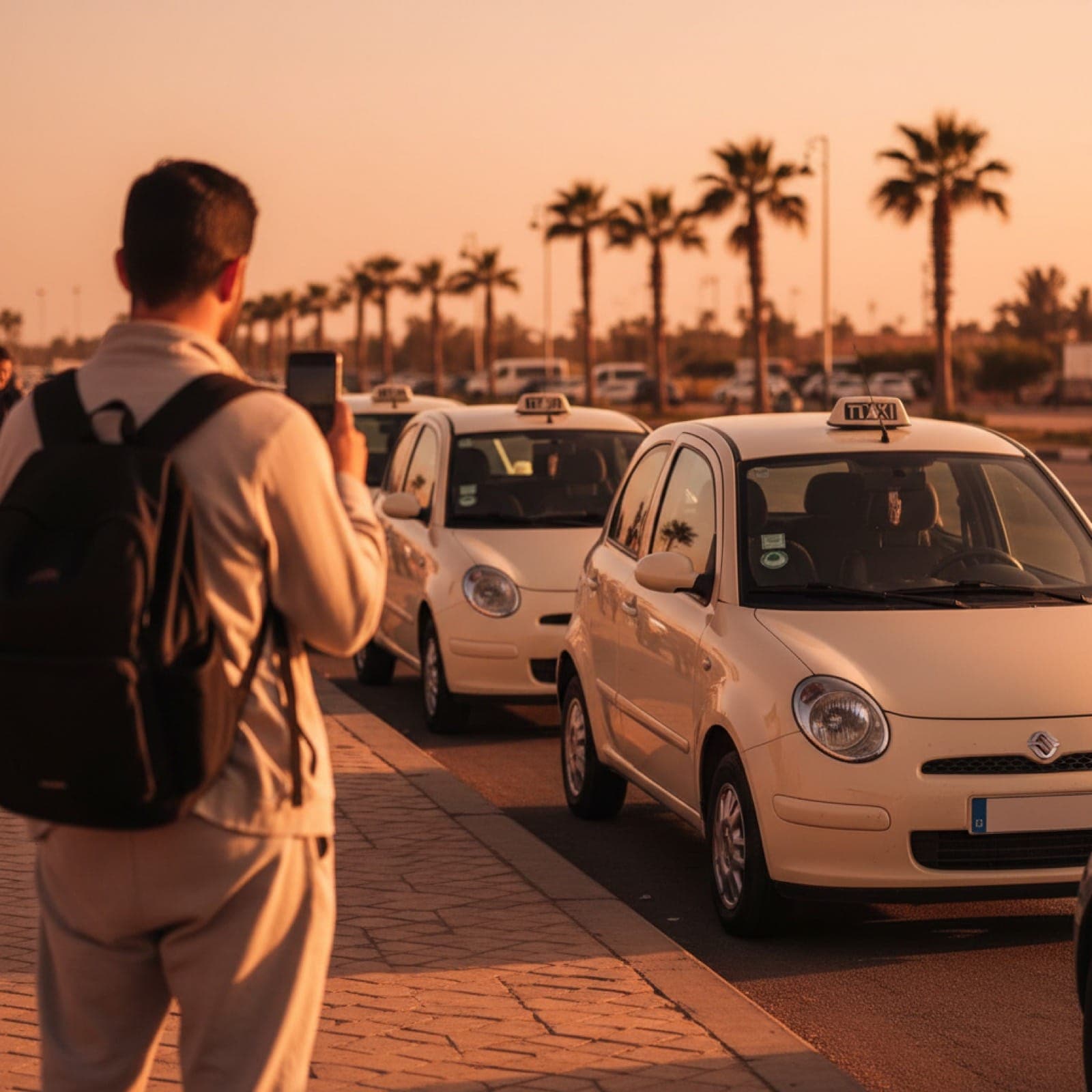
Because most riads cannot be reached by car. The medina's derbs are too narrow, so taxis and transfers drop you at the nearest vehicle point — often a square or gate — and you finish on foot, sometimes 5 to 15 minutes through unmarked alleys, hauling your own bags.
This is the detail that catches first-timers hardest, and it's why we rate transfer-and-luggage help as a top-tier feature, not a nicety. A good riad will send a staff member with a cart to meet you at the drop point, walk you in, and carry your cases — invaluable after a long flight, at night, or in summer heat. A great one arranges a private airport transfer that hands you off directly to that escort, so you never stand confused in an alley with a phone and no signal. Before you book, ask one concrete question: "Can someone meet us at the car and help with luggage to the door?" If the answer is vague, treat it as a warning. We build this handoff into every arrival and explain the airport-to-door logistics in our Marrakech airport private transfer guide.
How big a riad should you book, and does size change the experience?
Size changes the experience more than people expect. Smaller riads (4 to 6 rooms) feel intimate and home-like, with hosts who learn your name; larger ones (10-plus rooms, sometimes called maisons d'hôtes or boutique riad-hotels) offer more facilities, a fuller staff, and a bigger pool, but less of that personal warmth.
Match the size to your group and your taste. Solo travellers and couples chasing romance usually want a small, quiet riad where breakfast feels like staying with a generous friend. Families and groups of friends are often happier booking a whole small riad for exclusive use — privacy, a shared courtyard, and meals cooked to your schedule — or choosing a larger property with a proper pool and more space to spread out. If you're considering buying out an entire riad or stepping up to genuine five-star service with full facilities, that sits in luxury Morocco territory, where we hand-pick properties and staff around the group. There's no "best" size in the abstract — only the right size for who's travelling.
What are the red flags that signal a riad to avoid?
The biggest red flags are vagueness about the walk and luggage, no clear arrival instructions, dishonest photography, and missing essentials like working air-con or hot water. A riad that won't tell you plainly how you reach the door is a riad to skip.
Specific things we'd walk away from: listings with only courtyard close-ups and no honest shot of the actual bedroom (rooms are where the variation hides); reviews that repeatedly mention getting lost with no help arriving; no mention of how to find the place or who meets you; and silence on air-conditioning, heating, or hot-water reliability. Be wary, too, of a riad whose lowest rooms have no natural light — some interior rooms in old houses are dark, which suits some and depresses others, so ask. Finally, a faint warning sign: pushy upselling of in-house tours or transfers at inflated prices before you've even arrived. Honest riads explain trade-offs; the ones to avoid paper over them with beautiful photos and silence on the practicalities.
Riad or hotel — who should pick which?
Pick a riad if you want character, privacy, personal hosting, and the experience of staying inside the medina. Pick a hotel if you need step-free access, a lift, a gym or large pool, predictable uniform service, or you simply don't want to walk to your door through alleys.
The table below is the shorthand we use when a guest is genuinely torn. None of these are absolutes — there are riads with lifts and hotels with soul — but the tendencies are reliable enough to choose by. For the full argument, including a few hybrid options like riad-style hotels just outside the medina walls, see our dedicated riad vs hotel in Morocco comparison.
| Traveller type | Lean riad if… | Lean hotel if… | Our usual pick |
|---|---|---|---|
| Couple / honeymoon | You want romance, privacy, a candlelit courtyard | You want a spa-resort with a big pool | Small calm riad in Mouassine or a quiet derb |
| Family with young kids | You can book a whole riad for exclusive use | You need a kids' pool, lift, and space | Larger Kasbah-side riad, or a riad buyout |
| First-timer, short stay | You want to be inside the medina action | You're nervous about navigating alleys | Riad near Jemaa el-Fna with luggage escort |
| Older or mobility needs | Rarely — most riads have stairs, no lift | You need step-free access and a lift | Hotel, or a single-level riad near a gate |
| Slow traveller, 4+ nights | You value calm, hosting, and character | You want anonymity and full facilities | Garden riad in Dar el Bacha or the Kasbah |
What does a good Marrakech riad cost, and what should be included?
Prices vary enormously, so treat these as broad ranges only. A clean, characterful mid-range riad typically runs roughly €80-180 a night for two with breakfast; well-regarded boutique riads sit around €180-400; and the truly luxurious or whole-house buyouts climb well beyond that. Breakfast is almost always included.
What should be included as standard: daily breakfast (usually on the rooftop or in the courtyard), housekeeping, mint tea on arrival, and at least basic luggage help to the door. Air-conditioning and Wi-Fi are expected at the mid-range and up, though Wi-Fi can be patchy behind thick old walls. Dinner is often available on request (riad home-cooking is frequently the best meal of a trip) but charged separately. Hammam and spa treatments, in-house or arranged nearby, are extra. Airport transfers are sometimes bundled and sometimes added — confirm which. As a rule, what you're paying the premium for in a great riad is not square footage but location, the quality of the welcome, and the people who make the place run. For a wider picture of what things cost across the country, our note on whether Morocco is expensive sets sensible expectations.
In summary: how do you actually choose?
Choose your quarter first — buzz near Jemaa el-Fna or calm in the Kasbah, Mouassine, or Dar el Bacha. Then confirm the things that make or break the stay: a usable rooftop, a plunge pool if you're coming in summer, someone to meet you and carry bags to the door, honest room photos, and a breakfast and size that fit how you travel. Ignore star ratings; they were designed for hotels, not for converted courtyard homes. The best riad in Marrakech is simply the one that fits the trip you're actually taking — your group, your dates, your tolerance for noise, and your need for help getting in. Get those right and almost any well-run riad will give you one of the most memorable stays of your life.
If you'd rather not sift through hundreds of listings and guess at which alley you'll be hauling your bags down, that's exactly the part we take off your plate. Tell us your dates, your group, and how much buzz versus calm you want, and we'll match you to a riad we've personally vetted, arrange the airport-to-door handoff, and brief the staff before you land — start with our trip planner and we'll take it from there.
Written by
Amina Benkirane
Destination Editor
Writer and photographer covering the Maghreb. Ten years of wandering souks, kasbahs, and back roads most guidebooks miss.