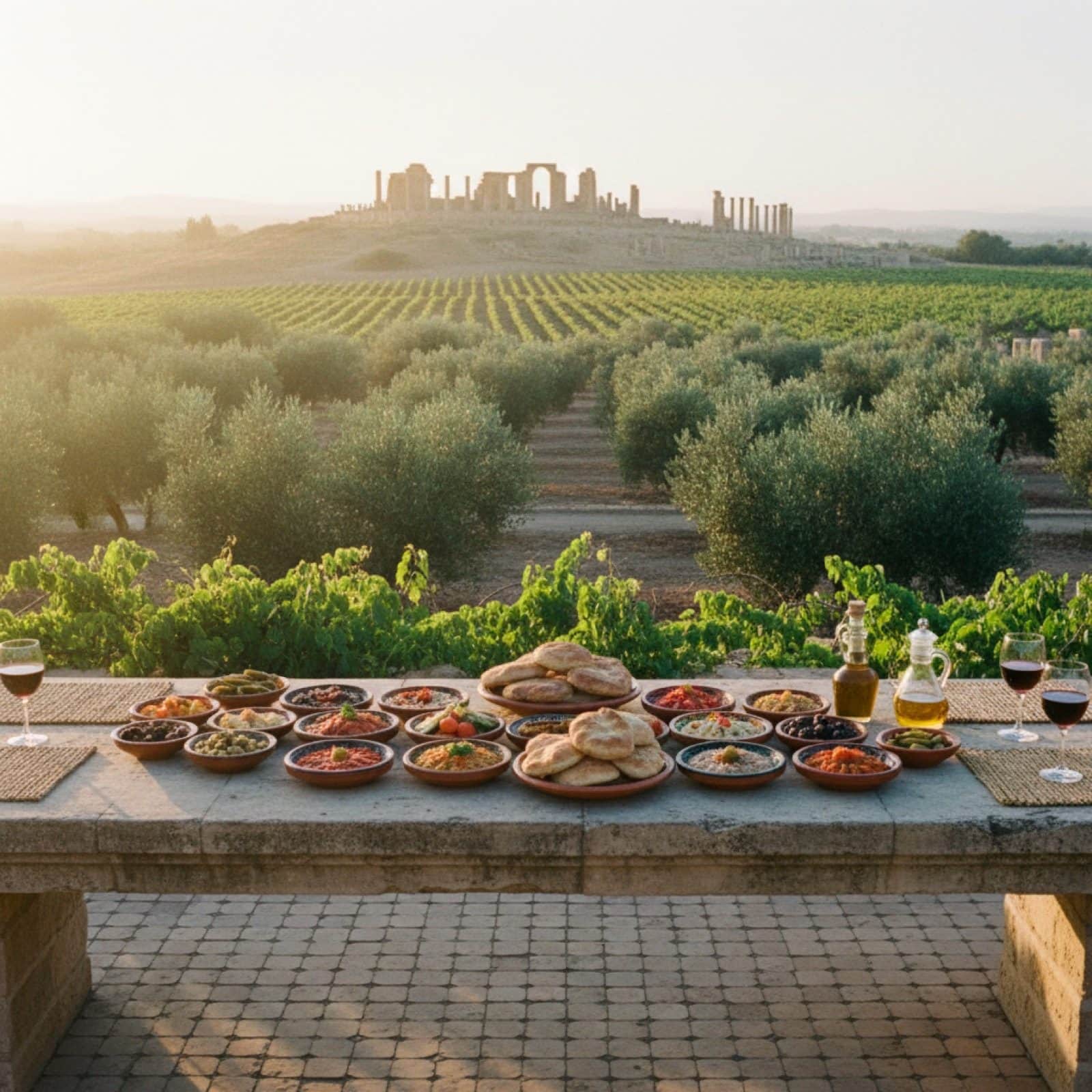
This Morocco food tour settles into Meknès — the imperial city at 550 metres on the Middle Atlas foothills that has become the country's quiet wine capital — and spends five days at the table and in the cellar. You taste Bordeaux-rooted reds where the vines meet the plain, press Picholine Marocaine olives at a working mill, and walk Volubilis among Roman oil presses that fed the same export trade two thousand years ago. The pace is the harvest's, not the guidebook's.
Morocco does not have many true appellation corners. The Meknès plain is the exception. In 1998 Les Celliers de Meknès secured the country's first and only AOC, Coteaux de l'Atlas, for its Château Roslane — the first estate in North Africa to earn the 'Château' designation. A few kilometres away, Domaine de la Zouina was planted in 2002 by two Bordeaux vignerons, men who had run Château Fieuzal and Larrivet Haut-Brion, on sixty-three hectares of clay-limestone. You taste both, side by side, and the lineage in the glass is unmistakable.
The olive is the plain's older crop. Fès-Meknès holds some 346,000 hectares of groves, almost all of it Picholine Marocaine, and the early October–December pressing yields the bitter, peppery, high-polyphenol oil the connoisseur travels for. You spend a morning at a mill watching the paste come off the stones, then carry that same oil into a market-to-table cooking class — the produce chosen with you that morning, the tagine built around a single estate's harvest.
Volubilis grounds all of it in time. The over-thirty stone presses still standing in the UNESCO ruins (inscribed 1997) are the same machinery, in principle, that you watched turning that morning. The marble columns of Meknès's Bab Mansour gate were quarried from these ruins by Moulay Ismaïl. Few tours let you read a region's whole agrarian record — Roman, imperial, modern — in a single valley.
Honest notes: this is a slow, seated, sensory trip, not a sightseeing sprint — if you want desert dunes or surf, look elsewhere in our line. Wine and olive oil are agricultural, so the experience peaks at harvest (September–October for the vendange, October–December for pressing) and in the April–May greening; mid-summer is hot and quiet at the estates. Morocco is a Muslim country and alcohol is served only at licensed estates and hotels, never publicly — your tastings are private and pre-arranged.
- Taste at Domaine de la Zouina, the French-founded estate planted in 2002 by ex-Château Fieuzal and Larrivet Haut-Brion vignerons — 63 hectares of Cabernet, Syrah and Chardonnay
- Stand among the thirty-plus Roman olive presses at Volubilis, the UNESCO site (inscribed 1997) that shipped oil to Rome 2,000 years ago
- Compare a Château Roslane 1er Cru — North Africa's first 'Château' classification and only AOC, Coteaux de l'Atlas, established 1998
- Learn Picholine Marocaine olive oil, Morocco's dominant cultivar, at a working mill in the 346,000-hectare Fès-Meknès olive belt
- Cook a market-to-table tagine in a guided Moroccan cooking class using single-estate oil and Meknès-plain produce
- Walk the Meknès medina (UNESCO, 1996) through Bab Mansour, its marble columns lifted from Volubilis by Sultan Moulay Ismaïl
- Time the trip to the September–October vendange or the October–December olive pressing for harvest-fresh, peppery, high-polyphenol oil (300–800 mg/kg)
- Two private estate lunches paired flight-by-flight, hosted at vineyard altitude of 550–700 m
Day by day
- Day 1
Fes arrival, transfer to Meknès
We collect you in Fes and drive the hour west to Meknès, your base for the week. After settling in, an orientation walk through the medina — a UNESCO site since 1996 — past the monumental Bab Mansour gate, its marble columns carried here from Roman Volubilis. A first dinner introduces the plain's table: preserved-lemon tagine, the region's olives, and a glass from a licensed Meknès estate to set the register.
Drive · 1h
- Day 2
Domaine de la Zouina & the Bordeaux lineage
A private morning at Domaine de la Zouina, founded in 2002 by two Bordeaux vignerons on sixty-three hectares of clay-limestone vines. You walk the rows, see the cellar, and taste the Volubilia range — Cabernet- and Syrah-led reds, a Chardonnay-Vermentino white, the gris — paired across a hosted vineyard lunch. The afternoon compares a Château Roslane 1er Cru from the country's only AOC, Coteaux de l'Atlas, so the lineage in each glass is explicit.
Stay overnight
- Day 3
Volubilis: Roman presses & the agrarian record
We spend the morning at Volubilis, the best-preserved Roman site in North Africa (UNESCO, 1997), reading its olive economy on the ground: over thirty stone presses still stand among the houses and oil complexes that exported to Rome. A specialist guide walks you from the triumphal arch to the press rooms. Lunch is at a farmhouse table on the Zerhoun slopes below the ruins, the produce and oil from the surrounding groves.
Stay overnight
- Day 4
Olive mill morning & market-to-table cooking class
An early visit to a working olive mill in the Fès-Meknès belt — 346,000 hectares, almost all Picholine Marocaine — to watch the early-harvest pressing and taste the fresh, peppery, high-polyphenol oil straight from the decanter. From there to the souk to choose the day's produce, then a hands-on Moroccan cooking class building a tagine and salads around a single estate's oil. You eat what you cook, with notes on pairing and provenance.
Stay overnight
- Day 5
Cellar farewell & return to Fes
A final unhurried tasting and the chance to ship favourites home, then the hour's drive back to Fes for onward travel or a connecting Morocco itinerary. We hand you a printed terroir dossier — estates, cultivars, harvest dates and the producers you met — so the bottles in your case keep their story.
End of journey
What's included
- Four nights in a hand-picked Meknès riad or boutique hotel with breakfast
- Private licensed driver-guide and air-conditioned vehicle throughout
- Two private, pre-arranged estate tastings with paired hosted lunches
- Volubilis entry with a specialist archaeology guide
- Working olive-mill visit with fresh-oil tasting
- Hands-on market-to-table Moroccan cooking class, ingredients included
- Printed terroir dossier of estates, cultivars and harvest dates
Not included
- International and domestic flights
- Travel insurance
- Lunches and dinners not specified in the itinerary
- Wine and oil purchases and home shipping fees
- Gratuities for guides and hosts
- Wine appellation
- AOC Coteaux de l'Atlas — Morocco's only AOC, set 1998
- Olive belt
- Fès-Meknès, 346,000 ha, mostly Picholine Marocaine
- Volubilis presses
- 30+ Roman olive presses, UNESCO since 1997
- Vineyard altitude
- 550–700 m on Middle Atlas foothills
“People are surprised Morocco has a real appellation corner, but the Meknès plain has the one AOC in the country and vines planted by Bordeaux hands. I pour the Zouina and a Château Roslane side by side, then walk guests through the Roman presses at Volubilis the next morning — same valley, same crops, two thousand years apart. You taste the lineage; you don't just hear about it.”
What past travellers say

Sophie & Marc
Paris, France
“The best trip of our lives. Our guide knew every village, every viewpoint, every hidden riad. Seven days in Morocco felt like a month somewhere else.”

James H.
London, UK
“Everything was seamless from landing in Fes to the Sahara camp and back to Marrakech. The night under the stars is something I'll never forget.”

Ana Rodrigues
Lisbon, Portugal
“Organized, warm, professional. They built the itinerary around what we loved and gave us complete freedom to stop anywhere along the way.”
Imperial Terroir: A Morocco Food Tour of Meknès, Volubilis & the Wine Country — frequently asked
- What does this Morocco food tour actually focus on?
- Gastronomy first, with wine and olive oil as the terroir pillars. Over five days based in Meknès you visit two wine estates with paired lunches, a working olive mill, the Roman oil presses at Volubilis, and a hands-on cooking class. It is built for travellers who want to understand a region through what it grows, presses and pours rather than tick monuments.
- Is there really a wine region near Meknès worth visiting?
- Yes. The Meknès plain holds Morocco's only AOC, Coteaux de l'Atlas, established in 1998, and Château Roslane was the first North African estate to earn the 'Château' designation. Domaine de la Zouina was planted in 2002 by two Bordeaux vignerons on 63 hectares. At 550–700 m altitude on the Middle Atlas foothills, this Meknès wine country is the country's most credible appellation corner.
- Can you drink wine in Morocco as a tourist?
- Yes, within the right setting. Morocco is a Muslim-majority country and alcohol is not sold or consumed publicly, but it is legally produced and served at licensed wineries, hotels and restaurants. Every tasting on this morocco wine tour is private and pre-arranged at licensed estates, so you enjoy the wines respectfully and in context, exactly where they are made.
- When is the best time for this morocco culinary tour?
- Two windows. September to October catches the grape vendange, when the estates are working and the cellars are alive. October to December is the olive pressing, when mills run fresh, peppery, high-polyphenol oil (300–800 mg/kg). April to May is green and mild with the vines flushing. Mid-summer is hot and quiet at the estates, so we steer toward the harvest seasons.
- What makes Volubilis relevant to a food and olive oil trip?
- Volubilis, a UNESCO site since 1997 and the best-preserved Roman city in North Africa, was an olive-oil export hub: over thirty stone presses still stand among its ruins, shipping oil to Rome 2,000 years ago. The same Picholine groves blanket the plain today. Seeing the ancient presses the day after a modern mill gives the whole region's agrarian story a single, legible thread.
- Does the trip include a Moroccan cooking class?
- Yes. After a morning at the olive mill you choose produce in the Meknès souk, then join a hands-on moroccan cooking class to build a tagine and salads around a single estate's oil. You cook it and eat it, with guidance on provenance and pairing. It is the practical counterpart to the tastings — the region's pantry put to work in your own hands.
- Which wines and olive cultivars will I taste?
- On the wine side, Domaine de la Zouina's Volubilia range — Cabernet- and Syrah-led reds, a Chardonnay-Vermentino white, the gris — and a Château Roslane 1er Cru from the Coteaux de l'Atlas AOC. On oil, Picholine Marocaine, Morocco's dominant cultivar across the 346,000-hectare Fès-Meknès belt, tasted fresh at the mill so you read its bitterness and pepper directly.
- Is this morocco gastronomy tour suitable if I am not a wine expert?
- Completely. The hosts and your guide pitch each tasting to your level, explaining the Bordeaux lineage, the AOC rules and the harvest cycle as you go. Wine is one of three pillars alongside olive oil and cooking, so non-drinkers and curious beginners are well served. The dossier you leave with means you can keep learning from the bottles you carry home.