The Moroccan dirham is a closed currency — you can't buy it before you fly, so you withdraw it from an ATM on arrival. Here's the honest, operator-tested playbook: how much cash to carry, which banks' ATMs to use, the airport rate trap, where cards actually work, and a worked daily-cash table — no scaremongering.
The Moroccan dirham (MAD) is a closed currency — you cannot buy it at home, so withdraw it from a bank ATM the moment you land. Morocco is cash-first for souks, taxis, tips and small riads; cards work fine at hotels, supermarkets and upscale restaurants.
I arrange and run trips here for a living, so this is the version I give my own travellers — not a guidebook guess. One number to anchor everything: roughly 10 dirhams to 1 US dollar (it drifts a little; the euro sits a touch higher, around 10.5–11 MAD). So when you see "200 MAD," think about $20. Keep that ratio in your head and Morocco stops feeling confusing very fast.
Can you buy Moroccan dirhams before you travel?
No — not officially, and not at a sensible rate. The dirham is a closed (non-convertible) currency, which by law cannot be freely exported or imported. You get yours on the ground, almost always from an ATM.
What this means in practice: don't waste time hunting for dirhams at your home bank or airport bureau before departure. If a currency desk back home does offer them, the rate will be poor and you'll be carrying a wad of cash you didn't need to. Bring a modest amount of your home currency (US dollars or euros) as a backstop, but plan to draw dirhams here. The central bank, Bank Al-Maghrib, sets the reference rate, and the spread you get from a normal bank ATM in Morocco will beat anything you'd have arranged in advance. The closed-currency rule is also why you should spend down your dirhams before you fly out — convert leftover cash back at the airport or, better, just don't over-withdraw in the first place.
Is Morocco cash or card?
Both — but cash leads. Treat Morocco as a cash-first country with a growing card layer. The rule of thumb: the smaller and more local the transaction, the more it wants cash; the more formal the business, the more likely it takes a card.
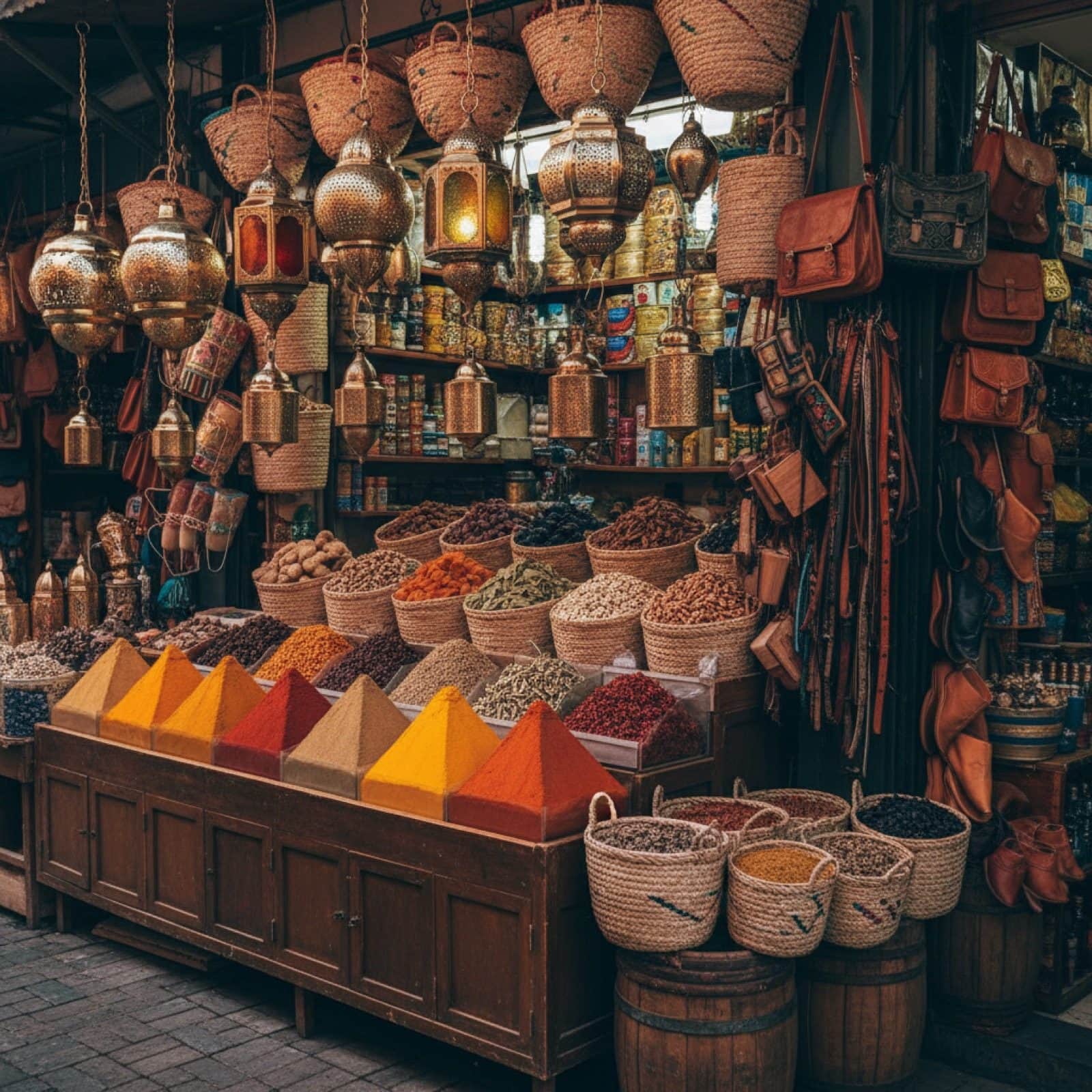
Souks, medina stalls, petit taxis, parking attendants, the man who carries your bags to the riad, mint tea at a roadside café, tips of every kind — all cash, all in dirhams. Most riads, mid-range restaurants, market traders and rural anything are cash too. Cards (Visa and Mastercard) are reliable at hotels, supermarkets like Marjane and Carrefour, petrol stations, pharmacies, fixed-price boutiques and upscale or tourist-facing restaurants in Marrakech, Fes, Casablanca and the coast. American Express is patchy — don't rely on it. The honest takeaway: you can pay for the big, planned things with a card, but the texture of a Morocco day — the haggling, the tipping, the small joys — runs on cash. Travel without dirhams in your pocket and you'll feel stranded inside an hour.
| Where | Cash or card? | Notes |
|---|---|---|
| Souks, medina stalls, markets | Cash | Haggling is a cash game; cards kill your bargaining power |
| Petit & grand taxis | Cash | Agree the fare first; carry small notes and coins |
| Tips (guides, drivers, porters, cafés) | Cash | You cannot tip with a card — keep 10s, 20s, 50s handy |
| Small riads & guesthouses | Cash (some take cards) | Ask when you book; many add a card surcharge |
| Hotels & palace-hotels | Card | Visa/Mastercard fine; Amex patchy |
| Supermarkets (Marjane, Carrefour) | Card | Contactless widely accepted in cities |
| Petrol stations | Card or cash | Cards work on main roads; carry cash for remote stations |
| Upscale / tourist restaurants | Card | Casual and local eateries are cash-only |
Which ATMs should you use in Morocco, and what about fees?
Use a major bank's own ATM — Attijariwafa Bank, Bank of Africa (formerly BMCE), Banque Populaire, CIH or Société Générale. They're everywhere in cities and at every airport, take foreign Visa and Mastercard, and are the safest, best-value way to get dirhams.
Two fees stack up. First, most Moroccan ATMs now charge a local withdrawal fee on foreign cards — typically a flat amount in the low tens of dirhams per withdrawal (broadly in the 20–35 MAD range, and it has crept up). Second, your home bank may add its own foreign-transaction or out-of-network fee. Because the local fee is per withdrawal, the move is simple: take out larger amounts less often rather than small sums repeatedly. When the screen asks whether to be charged in dirhams or your home currency, always choose dirhams — "dynamic currency conversion" in your own currency bakes in a worse exchange rate. Stick to ATMs physically attached to a bank branch or inside the airport, prefer daytime withdrawals, and shield the keypad. Standalone machines in tourist alleys are the ones to be wary of.
Withdrawal limits per transaction vary by bank — some cap a single withdrawal around 2,000 MAD, others allow more — so if you need a larger sum you may need two pulls. And the single most important admin job before you fly: tell your bank you're travelling to Morocco, or a fraud algorithm may freeze your card on the first dirham you try to draw. Bring a second card from a different network as a backup, stored separately.
How much cash should you carry in Morocco?
Carry enough for two to three days of cash spending at a time — for most travellers that's roughly 500–1,500 MAD ($50–150) in your pocket — and keep the rest locked in your room safe. Top up at an ATM every few days rather than walking around with a brick of notes.
How much you actually burn through depends entirely on your trip. On a private, mostly-inclusive tour where hotels, transport and many meals are pre-paid, your cash is really just tips, souvenirs, mint teas, entry tips and the odd taxi — call it $20–40 a day per person, plus whatever you set aside for shopping. Independent travellers handling their own riads, taxis and every meal in cash will move more. A practical rhythm: draw a few hundred dirhams at the airport on arrival for the first day's taxis, tips and water, then do a bigger withdrawal once you're settled in the city. Break big notes early. ATMs love to dispense 200 MAD bills, but taxi drivers and stallholders "never have change" — buy something small at a supermarket to crack them into 20s and 50s. Small notes are the real currency of a smooth Morocco trip.
Should you change money at the airport or a bureau de change?
For most people, skip the exchange counters and just use an airport ATM — the rate is better and the spread is smaller. If you do carry cash to exchange, Morocco's bureaux de change are fairly regulated and rates don't vary wildly, but ATMs still usually win.
Bank Al-Maghrib publishes the reference rate, and licensed bureaux (and bank counters) post rates close to it with a modest margin. Crucially, never accept a worse rate just for convenience and never change money with someone who approaches you on the street — that's a classic short-change setup, and it's illegal. If you land with leftover dollars or euros, an official airport or bank bureau is fine for a clean swap; bring your passport, as ID is sometimes requested. The smartest play at departure is to spend down your dirhams (closed currency, remember) and only convert a small remainder. One genuinely useful tip: keep the ATM/exchange receipt if you plan to change a larger sum of dirhams back at the end, as some counters ask for proof of the original exchange.
Do credit cards and contactless work in Morocco?
Yes — Visa and Mastercard work well in cities, and contactless ("sans contact") is increasingly common in hotels, supermarkets and modern shops. But card acceptance thins out fast the moment you leave the formal economy or the big towns.
In Marrakech, Fes, Casablanca, Rabat, Tangier and Agadir, tapping your card or phone at a supermarket or a smart restaurant is routine now. Outside that — in the medina, in villages, in the mountains and the desert, in petit taxis — assume cards simply aren't an option. Two operator warnings. First, some small businesses tack on a card surcharge (often a few percent) or have a minimum spend, and a few will claim "the machine is broken" to push you to cash — that's usually genuine in rural spots and tactical in tourist ones. Second, choose a card with no foreign-transaction fee if you can, and again, always pay in dirhams, not your home currency, when the terminal offers a choice. Mobile wallets (Apple Pay, Google Pay) work wherever contactless does, but they don't help you tip a porter or pay a taxi, so they never replace cash here.
“The travellers who struggle with money in Morocco aren't the ones who brought the wrong card — they're the ones who ran out of small dirham notes. Carry 20s and 50s like they're gold, and the whole country gets easier.”
— Youssef El Alaoui, Lead Morocco Specialist
How does cash work for tipping in Morocco?
Tipping runs entirely on small dirham cash — you cannot tip with a card. Budget roughly 10% in restaurants, a few dirhams to round up cafés and taxis, 10–20 MAD a bag for porters, and meaningfully more per day for a private guide and driver who make the trip.
This is the single biggest reason to keep a working float of 10s, 20s and 50s on you at all times. Tips here aren't the obligatory, percentage-policed ritual they are in the US, but they're genuinely woven into daily life — the parking attendant in the vest, the man who hauls your bags through the medina, the café where you sat for an hour — and the people who shape your trip most (your guide and driver) are tipped generously and at the end, in cash, in dirhams. Withdraw a little extra precisely so you're never caught short for a tip. For the full line-by-line breakdown of who to tip and how much, see our honest guide to tipping in Morocco — it pairs with this one.
What's a realistic daily cash budget in Morocco?
It depends almost entirely on whether your trip is pre-paid or pay-as-you-go. Below is a rough worked guide to the cash you'll physically hand over per person per day, on top of anything already booked. These are approximate ranges, not quotes.
| Spend type | Budget day | Mid-range day | Notes |
|---|---|---|---|
| Tips (guide, driver, porters, cafés) | 50–100 MAD | 150–300 MAD | Higher on a fully private trip with a dedicated driver-guide |
| Taxis / local transport | 20–80 MAD | 50–150 MAD | Agree the fare first; less if transport is included |
| Coffees, mint tea, water, snacks | 30–60 MAD | 60–120 MAD | The small joys add up — keep coins |
| A casual local meal (if not included) | 40–80 MAD | 100–250 MAD | Cash-only at most local eateries |
| Entry tips, restrooms, parking | 10–30 MAD | 20–50 MAD | Always coins and small notes |
| Shopping / souvenirs | Your call | Your call | Cash gives you bargaining power in the souk |
| Rough cash to carry / day | ~150–350 MAD | ~400–800 MAD | Top up every 2–3 days; safe stores the rest |
If you're weighing the overall cost of a trip rather than just daily cash, our breakdown of whether Morocco is expensive puts the bigger numbers — flights, riads, private guiding — in context, and is a Morocco tour worth it is honest about when paying for a private trip earns its keep versus going it alone.
How do you keep your money safe in Morocco?
Morocco is a friendly, low-violent-crime destination, but opportunistic pickpocketing happens in crowded medinas and markets — so split your money and stay aware, not anxious. The risks are mundane, not dramatic, and a few simple habits remove almost all of them.
- Split your cash and cards. Carry a day's float on you; leave the rest plus a backup card in the room safe.
- Use ATMs at bank branches or inside the airport, in daylight, and cover the keypad. Skip standalone machines in tourist alleys.
- Always choose dirhams at ATMs and card terminals — never your home currency.
- Keep a slim wallet for the souk with just small notes, so haggling and tipping never expose your whole stash.
- Tell your bank you're travelling and bring a second card on a different network, stored separately.
- Change money only at official counters — never with someone who stops you on the street.
In summary: what should you actually do about money in Morocco?
In summary: don't buy dirhams before you come — the currency is closed, so withdraw on arrival from a major bank's ATM (Attijariwafa, Bank of Africa, Banque Populaire), take out larger sums less often to dodge per-withdrawal fees, and always choose to be charged in dirhams. Treat Morocco as cash-first — souks, taxis, tips and small riads need notes and coins, while hotels, supermarkets and upscale restaurants take cards and increasingly contactless. Carry a couple of days' cash at a time, break big 200 MAD notes early, hoard your 20s and 50s for tips, and tell your bank before you fly. Do those things and money is a non-issue. The travellers who run into trouble are simply the ones who arrive with no cash and no plan.
If you'd rather not think about any of this — if you want a trip where the hotels, transfers, guiding and most meals are handled, and the only cash you touch is the fun stuff and the tips — that's exactly what a well-run private trip removes. Tell us how you like to travel and we'll build an honest, all-in plan, and brief you on the small cash you'll want so nothing about money ever feels like guesswork.
Written by
Youssef El Alaoui
Lead Morocco Specialist
Born in Fes, based in Marrakech. Designs private itineraries for Morocco Beauty Spots and still argues mint tea is best in the Atlas.