Morocco's Sahara has Bortle Class 1 skies — the darkest there are — where the Milky Way casts shadows and you can see a galaxy 2.7 million light-years away with the naked eye. Here's where to go, when the galactic core is visible, how dark each site really is, and why Oukaïmeden Observatory is the science behind the romance.
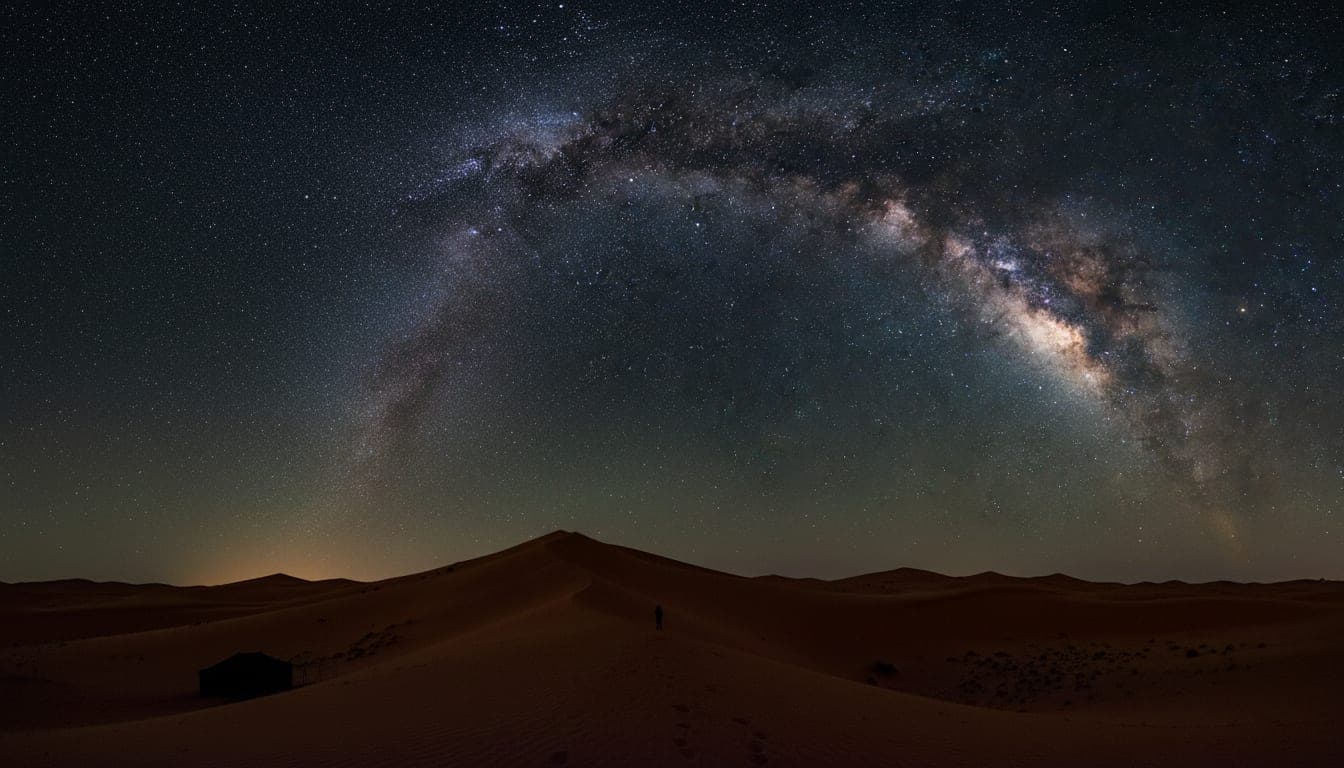
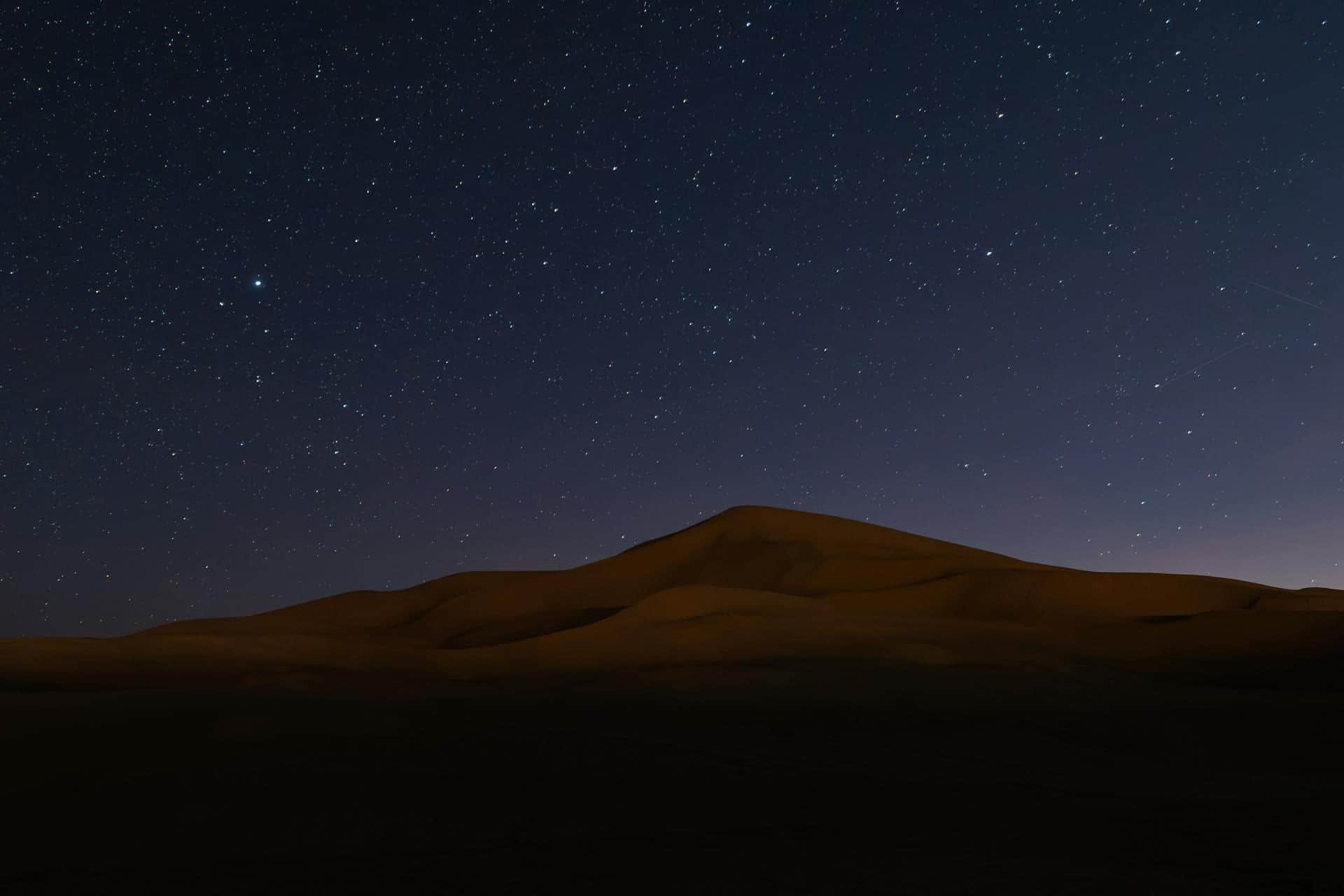
Morocco has some of the darkest skies on Earth. The Sahara around Erg Chebbi and Erg Chegaga rates Bortle Class 1–2 — the darkest tier on the nine-point scale — where the zodiacal light glows, the Milky Way is bright enough to cast a faint shadow, and the Triangulum Galaxy (M33), 2.7 million light-years away, is visible to the naked eye. The best time for the Milky Way's bright core is April–September, on the new moon. And high in the Atlas, the Oukaïmeden Observatory at 2,750 m is the working science behind the romance. Here's the full guide.
I've photographed the night sky from a lot of places, and the first time the Milky Way threw a shadow on the sand at Erg Chebbi I genuinely didn't believe it. Most of us have never seen a truly dark sky — roughly 80% of the world now lives under skies too bright to see the galaxy at all. Morocco is one of the easier places on Earth to fix that.
How dark is the Moroccan Sahara, really?
Genuinely, world-class dark. The Bortle scale runs from Class 1 (the darkest possible) to Class 9 (inner-city). Erg Chebbi (near Merzouga) and Erg Chegaga rate Class 1–2, equivalent to the world's best dedicated observatory sites. Under that sky you'll see roughly 4,000 stars with the naked eye, versus a few hundred from a European city. Merzouga gets more than 300 clear nights a year. The practical markers of a true dark sky — the zodiacal light, a shadow-casting Milky Way, naked-eye M33 — are all visible here.
When is the best time to stargaze in Morocco?
Two answers, and they matter. For comfort and clear skies, September–May avoids the worst desert heat. For the Milky Way's bright galactic core — the showpiece, the arching band most people picture — the window is April–September, peaking May–August, when the core rises high into the southern sky. And whatever the month, aim for the new moon (±3 days): moonlight is the enemy of a dark sky, and a full moon will wash out even Bortle 1. Late-spring and early-autumn new moons are the sweet spot, combining the core with bearable temperatures.
| Window | Galactic core | Conditions | Best for |
|---|---|---|---|
| Apr – Jun (new moon) | Rising, excellent | Mild nights | Milky Way core + comfort |
| Jul – Aug (new moon) | Peak, highest | Hot days, warm nights | The classic arching core |
| Sep – Oct (new moon) | Setting, still good | Mild, stable air | Core + pleasant temps |
| Nov – Mar (new moon) | Not visible | Cold nights, very clear | Winter sky: Orion, star fields |
Where should you go — Erg Chebbi, Erg Chegaga, or Agafay?
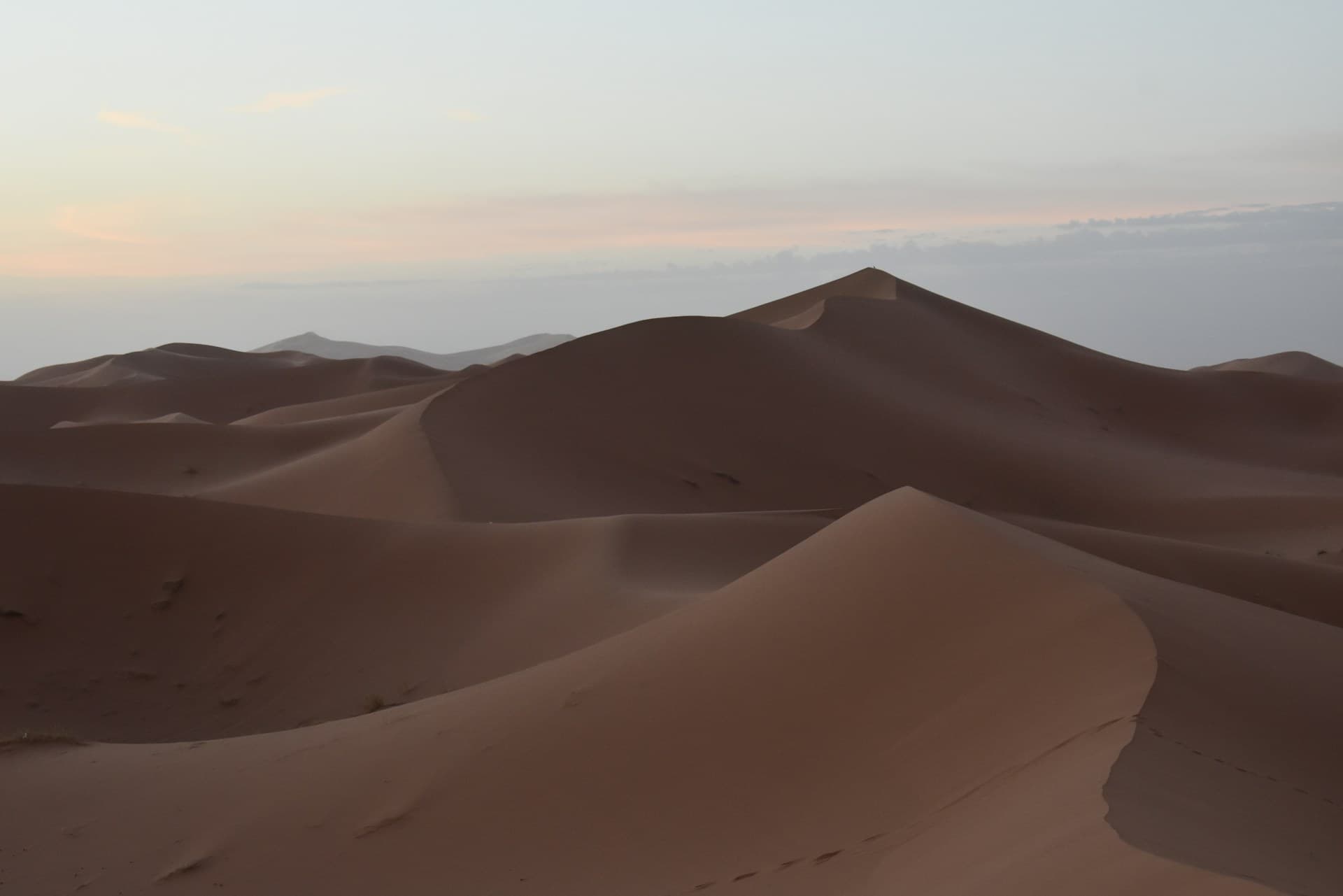
Erg Chebbi (Merzouga) is the classic: huge dunes, easy to reach, genuine Bortle 1–2 skies, lots of desert camps. Erg Chegaga (near M'Hamid) is more remote and arguably even darker, with no light on any horizon, but it's a longer, rougher drive. Agafay, an hour from Marrakech, is convenient and marketed hard as a 'desert', but it sits under Marrakech's light dome and is nowhere near as dark — fine for a city-break taste of stars, not for serious dark-sky observing. If dark sky is the goal, the long drive to Erg Chebbi or Chegaga is the price of the real thing. Our guide to Merzouga versus Zagora covers the desert-camp logistics in detail.
What is the Oukaïmeden Observatory, and can you visit?
Oukaïmeden Observatory sits at 2,750 m in the High Atlas, about 80 km and under two hours from Marrakech — built by Cadi Ayyad University and registered with the International Astronomical Union, with around 280 observable nights a year. It hosts TRAPPIST-North, a 0.6-metre robotic telescope. One honest clarification, because it's often overstated: the famous TRAPPIST-1 system of seven Earth-sized planets was discovered in 2016 by TRAPPIST-South in Chile, not from Morocco. Oukaïmeden's TRAPPIST-North is the northern-hemisphere partner that contributes follow-up and monitoring. It's a genuine working research observatory, and visiting it connects the desert's romance to real science — but it didn't discover the planets, and anyone telling you it did is overselling.
Do you need a telescope, and what will you see?
You don't need to own one — good astrotourism operators provide a telescope and an astronomer to drive it. With the naked eye under a Bortle 1 sky you'll see the Milky Way, the zodiacal light, M31 (Andromeda) and M33 (Triangulum), and thousands of stars. Through a telescope: the moons and belts of Jupiter, Saturn's rings, the Orion Nebula in winter, globular clusters and galaxies in summer. For astrophotography, a tracking mount turns the galactic core into the shot you came for — May–August, new moon, is when to attempt it.
Why does the dark sky matter beyond the view?
Because it's vanishing. Global light pollution is rising nearly 10% a year, doubling sky brightness roughly every seven to eight years, and about 80% of people now live where they can't see the Milky Way. It's an ecological loss too, not just an aesthetic one: even African dung beetles navigate by the Milky Way, and under light pollution they lose their bearings. Morocco's proposed Atlas Dark Sky reserve over Toubkal would be the first in North Africa. Part of the case for going now is simply that the dark itself is a resource worth valuing while it lasts.
If you'd like the guided version — Oukaïmeden's science paired with two nights under Bortle 1 skies at Erg Chebbi, astronomer-led, telescope provided, every departure timed to the new moon — that's our Dark Sky & Deep Time tour. Or use this guide to plan your own: pick a new-moon week, head for Erg Chebbi or Chegaga, and look up.
Written by
Amina Benkirane
Destination Editor
Writer and photographer covering the Maghreb. Ten years of wandering souks, kasbahs, and back roads most guidebooks miss.