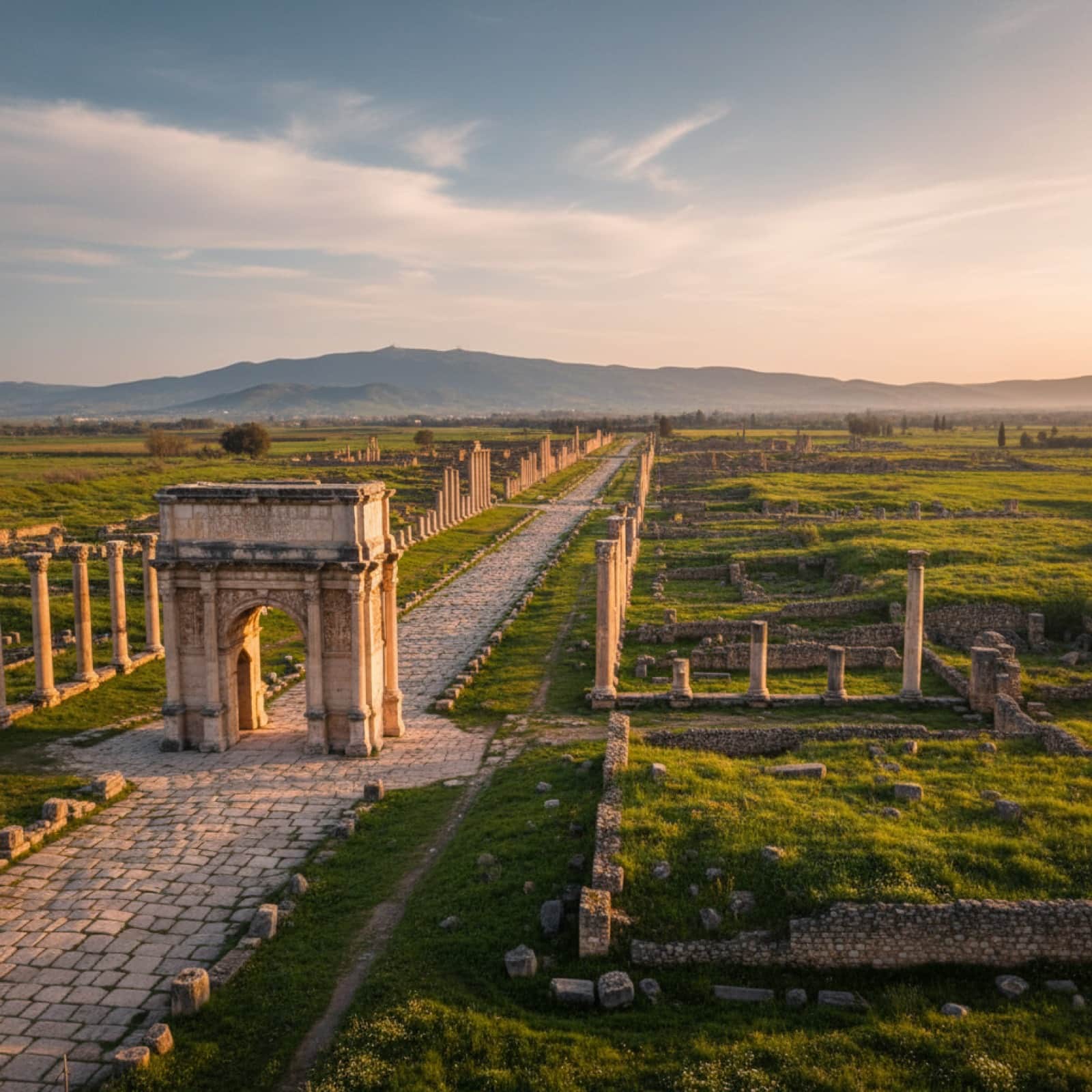
Volubilis is Morocco's best-preserved Roman city — a UNESCO World Heritage Site of mosaics and marble near Meknès. Here is how to visit, what to see, and how to get there.
Volubilis is the best-preserved Roman archaeological site in Morocco — a UNESCO World Heritage Site since 1997, set on a fertile plain about 30 km north of Meknès. You go for its in-situ floor mosaics, triumphal arch, and the open silence of a city that olive oil once made rich.
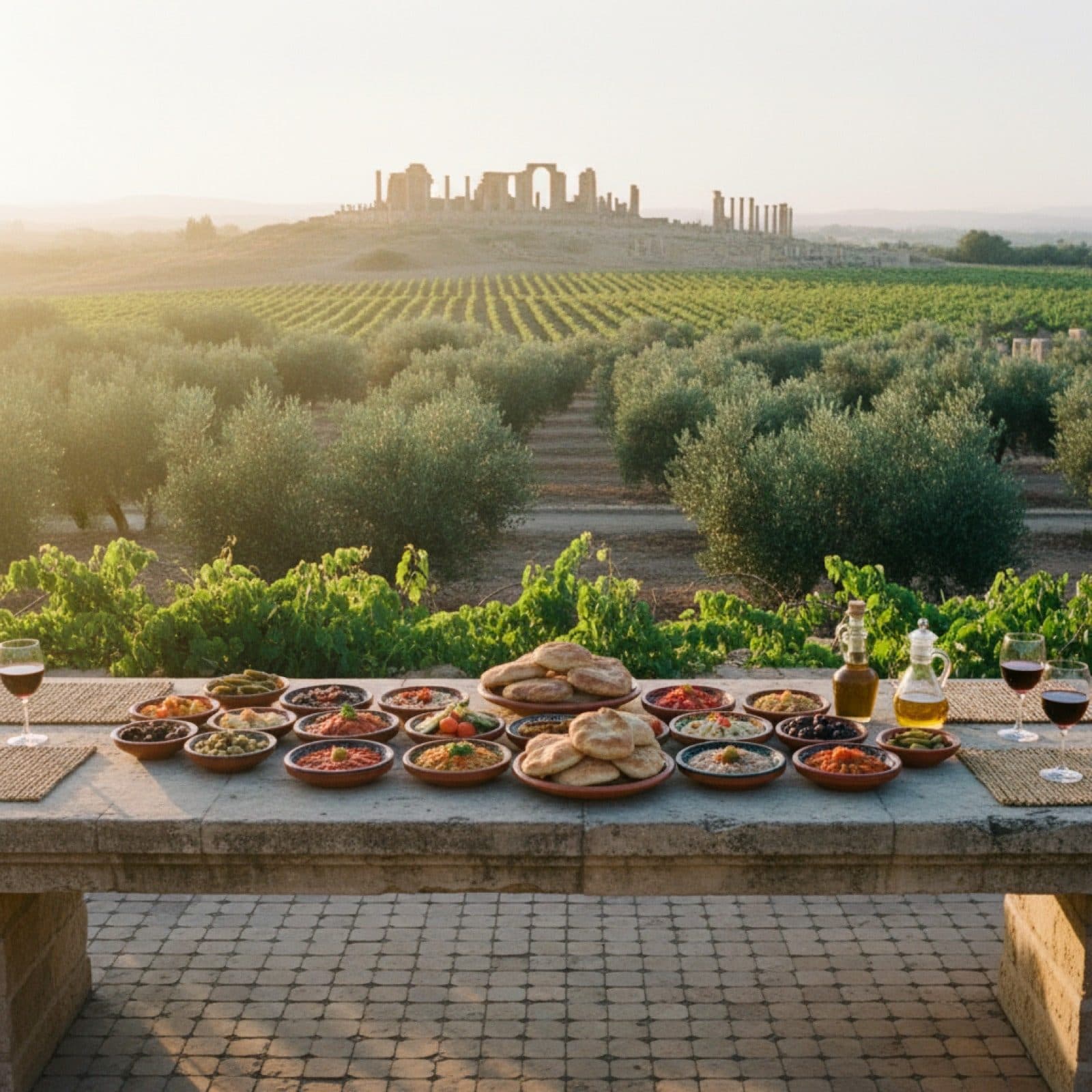
The evidence is in the stone. Excavations have traced the site from a 3rd-century-BC Berber and Mauretanian settlement through its years as a capital under King Juba II, into a thriving Roman city in the province of Mauretania Tingitana. Marble columns, a paved main street, and dozens of olive presses survive across roughly 40 hectares — material proof of a frontier town that prospered for centuries before Rome withdrew around the late 3rd century AD.
When we bring guests here, the first thing we say is: slow down. Most visitors treat Volubilis as a photo stop on the road between Fes and Meknès. But this is a city you read on foot. The mosaics are still on the ground where they were laid, the arch still frames the same hills, and a good guide turns a field of broken columns into a living account of who lived here and how. That difference — context — is the whole point of coming.
What exactly is Volubilis?
Volubilis was a Roman provincial city on the empire's southwestern edge, built on far older foundations. It began as a Mauretanian settlement and became prominent under Juba II, the scholar-king Rome installed over Mauretania around 25 BC. After the kingdom was annexed, Volubilis served as an important administrative and commercial center of Mauretania Tingitana, the Roman province covering northern Morocco. Its wealth came from the surrounding plain: grain, and above all olive oil, pressed in workshops whose stone basins you can still walk past. At its height the city held thousands of inhabitants. Today its ruins are the most complete window into Roman life anywhere in Morocco — and one of the most important Roman sites in North Africa.
Where is Volubilis and how do you get there?
Volubilis sits about 30 km north of Meknès, just below the sacred hilltop town of Moulay Idriss Zerhoun. From Fes it is roughly a 1 to 1.5 hour drive. There is no train station and no convenient public bus to the gate, which is the single biggest planning friction visitors run into. Most independent travelers reach it by grand taxi from Meknès or Moulay Idriss, or by a hired car and driver from Fes. The table below shows the realistic options.
| From | Distance | Time | How |
|---|---|---|---|
| Meknès | ~30 km | 40–45 min | Grand taxi or private car |
| Moulay Idriss | ~5 km | 10 min | Grand taxi or short drive |
| Fes | ~70 km | 1–1.5 hrs | Private car/driver (best) |
| Rabat | ~150 km | 2–2.5 hrs | Private car/driver |
What are the must-see monuments at Volubilis?
The site rewards a route rather than a wander. Enter near the museum and visitor center, then work up toward the civic core: the Basilica and Capitoline Temple sit at the heart of the old city, and the Arch of Caracalla (AD 217) crowns the far end of the main avenue. The grandest stretch is the Decumanus Maximus, the colonnaded main street, lined with the houses that hold the famous mosaics. Watch the ground as much as the skyline — much of what makes Volubilis extraordinary is underfoot.
| Monument | What to look for |
|---|---|
| Arch of Caracalla | Triumphal arch from AD 217 closing the main street |
| Capitoline Temple | Steps and columns of the city's principal temple |
| Basilica | Roofless law-court hall beside the forum |
| Decumanus Maximus | The colonnaded main avenue lined with townhouses |
| Olive presses | Stone basins and counterweights from oil workshops |
Why are the Volubilis mosaics so famous?
Because they are still where the Romans laid them, open to the sky in the floors of the houses they decorated. Unlike most sites, where mosaics are lifted into museums, Volubilis keeps many in situ. Look for the House of Orpheus, with its musician charming the animals; the House of the Labours of Hercules, picturing the hero's twelve trials in panels; the House of Dionysus (Bacchus); and the Knight's House. These floors show daily life, myth, and a frontier town's taste for Mediterranean culture. Seeing them in their rooms — not behind glass — is the closest most travelers get to standing inside a Roman home.
When is the best time to visit Volubilis?
Early morning or late afternoon, almost regardless of season. The site is open daily and has almost no shade — the plain is exposed, and a midsummer noon here is punishing. Arrive at opening for soft light and cool air, or come in the last two hours before close, when the low sun rakes across the columns and the mosaics read best for photographs. Spring brings green fields and wildflowers around the ruins; autumn is mild and clear. For the wider picture of seasons across the country, see our guide to the best time to visit Morocco.
What happened to the city after Rome left?
Volubilis did not vanish overnight. After Rome withdrew from the region around the late 3rd century AD, the city carried on in reduced form for centuries and kept a Latin-speaking and Christian population well beyond imperial rule. Decline came gradually, then sharply: the great Lisbon earthquake of 1755 brought down standing structures, and under Sultan Moulay Ismail much of the dressed stone was carried off to build the imperial walls and gates of nearby Meknès. What you see today is what survived robbing, ruin, and earthquake — which makes the surviving arch and mosaics all the more striking.
How long should you spend at Volubilis?
Plan on 1.5 to 2 hours on site for an unhurried visit — long enough to walk the Decumanus, find the main mosaic houses, and reach the Arch of Caracalla without rushing. There is an on-site museum and visitor center worth a short stop, and official guides wait at the entrance; hiring one is the single best way to make sense of the stones. Two hours lets you absorb it; less than an hour turns a world-class site into a blur. If you are tight on time, prioritize the mosaics and the arch over a complete circuit.
Can you combine Volubilis with Meknès and Moulay Idriss?
Yes — and you should. The three sit within a short drive of each other and make a natural day. Moulay Idriss Zerhoun, the whitewashed pilgrimage town named for the founder of Morocco's first dynasty, is barely 5 km from the ruins and offers a hilltop lunch with a view. Meknès, with its monumental Bab Mansour gate and the granaries of Moulay Ismail, completes the arc from Roman to imperial Morocco in a single afternoon. This trio is one of the best half- to full-day loops in the country; we fold it into our imperial cities itineraries as the cultural anchor between Fes and Meknès.
Is Volubilis worth visiting if you're not a history buff?
Honestly, yes — but with context. On its own, a field of columns and low walls can underwhelm a traveler who arrives cold. With a guide, or even a printed plan, the same field becomes a town you can populate: the bakery, the bathhouse, the rich family's mosaic floor, the press that made their fortune. The setting helps too — green plain, hills, the white town of Moulay Idriss above. If you are already touring the imperial cities or driving north toward Fes, Volubilis is an easy, rewarding addition rather than a detour.
In summary: how to do Volubilis well
Volubilis is Morocco's finest Roman site: a UNESCO-listed city 30 km north of Meknès, built up from a Mauretanian settlement, made rich by olive oil under Mauretania Tingitana, and left with its mosaics still in place. Go early or late for light and to beat the heat, spend at least 1.5–2 hours, take a guide to read the stones, and pair it with Moulay Idriss and Meknès for a full day that runs from Roman to imperial Morocco. The hardest part is simply getting there — and that is worth planning before you go.
The honest friction with Volubilis is access and meaning: there is no train or easy bus to the gate, and a field of ruins gives up little without someone to interpret it. We solve both. Our Meknès terroir & Volubilis private day puts you at the ruins early with an expert guide who brings the mosaics and the city to life, then adds Moulay Idriss and a taste of the region's olive country — door to door from Fes or Meknès, at your pace. If you want Roman Morocco done properly, let us drive and guide it.
Written by
Amina Benkirane
Destination Editor
Writer and photographer covering the Maghreb. Ten years of wandering souks, kasbahs, and back roads most guidebooks miss.